


// Workers AI · dad joke modeWhat did Erythronium rostratum say? "I'm a little trout-ally faded.
| Yellow fawn lily | |
|---|---|
 | |
Scientific classification  | |
| Kingdom: | Plantae |
| Clade: | Embryophytes |
| Clade: | Tracheophytes |
| Clade: | Angiosperms |
| Clade: | Monocots |
| Order: | Liliales |
| Family: | Liliaceae |
| Subfamily: | Lilioideae |
| Genus: | Erythronium |
| Species: | E. rostratum |
| Binomial name | |
| Erythronium rostratum | |

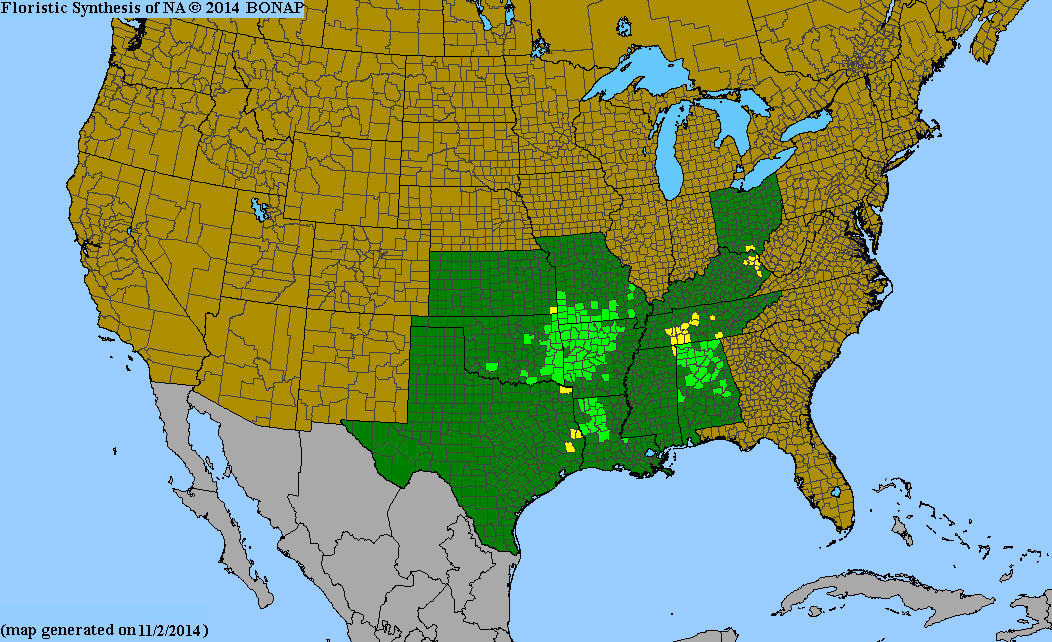
Erythronium rostratum, the yellow trout lily,[2] yellow fawnlily,[3] beaked trout lily,[2] or golden-star,[4] is a plant species native to the south-central part of the United States (Kansas, Missouri, Oklahoma, Ohio, Texas, Alabama, Arkansas, Kentucky, Louisiana, and Tennessee).[5][6]
Erythronium rostratum produces egg-shaped bulbs up to 20 mm long. Leaves are lanceolate, up to 20 cm long. Scape is up to 10 cm tall, bearing one yellow flower.[7][8]
References
[edit]- ↑ "NatureServe Explorer 2.0". explorer.natureserve.org.
- 1 2 "Erythronium rostratum page". www.missouriplants.com.
- ↑ "Kansas Wildflowers and Grasses - Yellow fawn lily". kswildflower.org.
- ↑ "golden-star". ODNR. Ohio Department of Natural Resources. Retrieved 29 January 2021.
- ↑ Kew World Checklist of Selected Plant Families
- ↑ Biota of North America Project
- ↑ Flora of North America v 26 p 162
- ↑ Wolf, Wolfgang. 1941. Castanea 6(2): 24–26, pl. 1.
External links
[edit] Media related to Erythronium rostratum at Wikimedia Commons
- photo of herbarium specimen at Missouri Botanical Garden, Erythronium rostratum, collected in Missouri

.JPG) | This Liliales article is a stub. You can help Wikipedia by adding missing information. |