


// Workers AI · dad joke modeIs Elsie Ferguson an actress? Does she ferguson-get her lines?
 | This article needs more citations. (December 2008) |
Elsie Ferguson | |
|---|---|
 Publicity photo of Ferguson (1913) | |
| Born | August 19, 1883 New York City, U.S. |
| Died | November 15, 1961 (aged 78) New London, Connecticut, U.S. |
| Occupation | Actress |
| Years active | 1902–1943 |
| Spouse(s) | Frederick C. Hoey (1907-1914) (divorced) Thomas Clarke, Jr. (1916-1923) (divorced) Frederick Worlock (1924–1930) (divorced) Victor Augustus Seymour Egan (1934–1956) (his death) |
Elsie Louise Ferguson (August 19, 1883 – November 15, 1961) was an American stage and film actress.[1] Seen by some as an early feminist, she promoted suffrage, which she discussed in interviews, and supported animal rights.[2][3]
Early life
[edit]Born in New York City, Elsie Ferguson was the only child of Hiram and Amelia Ferguson.[citation needed] Her father was a successful attorney.[4] Raised and educated in Manhattan, she became interested in the theater at a young age and made her stage debut at 17 as a chorus girl in a musical comedy. For almost two years, from 1903 to 1905, she was a cast member in The Girl from Kays. In 1908, she was leading lady to Edgar Selwyn in Pierre of the Plains. By 1909, after several years apprenticeship under several producers, including Charles Frohman, Klaw & Erlanger, Charles Dillingham and Henry B. Harris, she was a major Broadway star, starring in Such a Little Queen. In 1910, she spent time on the stage in London. Actresses Evelyn Nesbit and Ethel Barrymore were friends of hers.
During World War I, a number of Broadway stars organized a campaign to sell Liberty Bonds from the theatre stage before the performance as well as at highly publicized appearances at places such as the New York Public Library. On one occasion, Ferguson is reputed to have sold $85,000 worth of bonds in less than an hour.
Stardom
[edit]
At the peak of her popularity, several film studios offered her a contract but she declined them all until widely respected New York-based French director Maurice Tourneur proposed she appear in the lead role as a sophisticated patrician in his 1917 silent film Barbary Sheep. She also may have consented to films because she no longer had the protection of her Broadway employers Henry B. Harris, who died on the Titanic in 1912, and Charles Frohman, who perished on the Lusitania in 1915. Producer and director Adolph Zukor then signed her to an 18-film, three-year, $5,000-per-week contract.[5]
Following this first film, Ferguson was billed prominently in promotional campaigns,[citation needed] and starred in two more films directed by Tourneur under a lucrative contract from Paramount Pictures that paid her $1,000 per day of filming in addition to her weekly contract income. Her only surviving complete silent film is The Witness for the Defense (1919), co-starring Warner Oland and performed as a play in 1911 by her friend Ethel Barrymore.[5] A surviving fragment of footage of Ferguson from The Lie or The Avalanche can be seen in Paramount's The House That Shadows Built (1931). Other brief surviving footage of Ferguson is preserved in Paramount's A Trip to Paramountown (1922)

Continuing to play roles of elegant society women, Ferguson was quickly dubbed "The Aristocrat of the Silent Screen", but the aristocratic label also was because she was known as a difficult and sometimes arrogant personality with whom to work.[citation needed] Many of the films she agreed to do were because they were adaptations of stage plays with which she was familiar.
Elsie Ferguson eventually followed the move west and bought a home in the hills of Hollywood, California. In 1920, she traveled to the Middle East and Europe. She fell in love with Paris and the French Riviera, and within a few years, she bought a permanent home there.
In 1921, she accepted another contract offer from Paramount Pictures to star in four films to be spread over a two-year period. One of these was the 1921 film entitled Forever in which she starred with Wallace Reid.
"Talkies" and retirement
[edit]Ferguson's last silent film before returning to Broadway was the 1925 drama The Unknown Lover. In 1930, she made her first sound film that also would be her final film, titled Scarlet Pages, which is now preserved in the Library of Congress.[5] The film was based on a 1929 Broadway production of the same name that she also starred in. She was described as having a "pleasantly low-pitched voice with perfect diction."[6]
Well known as difficult to work with, temperamental, and argumentative,[citation needed] she married four times. Following her final marriage at age 51, she and her husband Victor Egan acquired an estate in Connecticut called White Gate Farms, and divided their time between it and her home in Cap d'Antibes.
Ferguson made her final appearance on Broadway in 1943, at the age of 60, that met with critical acclaim. She played in Outrageous Fortune,[6] a play written by her neighbor Rose Franken. The play closed eight weeks after it opened. Critics hailed Ferguson's performance as "glowing" and having "the charm and winning manner of old."[citation needed]
Personal life and death
[edit]Ferguson was first married to professional baseball manager Fred Hoey, from 1907 until their divorce in 1914.[7] She married Thomas Benedict Clarke, Jr. in 1916; they divorced in 1923.[8] In 1924, in Great Neck, Long Island, she married fellow actor Frederick Worlock; they divorced in 1930.[7] Her fourth and last husband was Victor A.S. Egan, whom she married in 1934; this marriage lasted until his death in 1956.
Ferguson died in Lawrence Memorial Hospital in New London, Connecticut, in 1961.[9] She was interred in Duck River Cemetery in Old Lyme, Connecticut. A very wealthy woman with no heirs and a lover of animals, she left a large part of her considerable estate to a variety of charities, including several for animal welfare.
Filmography
[edit]

| Year | Title | Role | Notes |
|---|---|---|---|
| 1902 | Jack and the Beanstalk | Fairy | |
| 1917 | Barbary Sheep | Lady Katherine 'Kitty' Wyverne | Lost film Eight minutes survive |
| 1917 | The Rise of Jennie Cushing | Jenny Cushing | Lost film |
| 1918 | Rose of the World | Rosamond English | |
| 1918 | The Song of Songs | Lily Kardos | Lost film |
| 1918 | The Lie | Elinor Shale | Lost film |
| 1918 | A Doll's House | Nora Helmer | Lost film |
| 1918 | The Danger Mark | Geraldine Seagrave | Lost film |
| 1918 | Heart of the Wilds | Jen Galbraith | Lost film |
| 1918 | The Spirit That Wins | Elsie | Short Lost film |
| 1918 | Under the Greenwood Tree | Mary Hamilton | Lost film |
| 1919 | His Parisian Wife | Fauvette | Lost film |
| 1919 | The Marriage Price | Helen Tremaine | Lost film |
| 1919 | Eyes of the Soul | Gloria Swann | Lost film |
| 1919 | The Avalanche | Chichita / Madame Delano / Helene | Lost film |
| 1919 | A Society Exile | Nora Shard, aka Christine | Lost film |
| 1919 | The Witness for the Defense | Stella Derrick | |
| 1919 | Counterfeit | Virginia Griswold | Lost film |
| 1920 | His House in Order | Nina Graham | Lost film |
| 1920 | Lady Rose's Daughter | Julie le Breton / Lady Rose / Lady Maude | Lost film |
| 1921 | Sacred and Profane Love | Carlotta Peel | Lost film |
| 1921 | Footlights | Lisa Parsinova / Lizzie Parsons | Lost film |
| 1921 | Forever | Mimsi | Lost film |
| 1922 | Outcast | Miriam | Lost film |
| 1922 | A Trip to Paramountown | Herself | Documentary short |
| 1924 | Broadway After Dark | Herself | Short Lost film |
| 1925 | The Unknown Lover | Elaine Kent | Lost film |
| 1930 | Scarlet Pages | Mary Bancroft |
References
[edit]- ↑ Rector, T.A. (2010). The Singing Heart: The Autobiography of Thomas Allen Rector. United States: Salmon Creek Publishing. p. 195. [ISBN missing]
- ↑ Parsons, Louella (1919). "Elsie Ferguson". New York Telegraph.
- ↑ "Women's Suffrage and the Movie People". Retrieved February 9, 2023.
- ↑ Great Stars of the American Stage by Daniel Blum, 2nd ed. c. 1954 Profile #64 [ISBN missing]
- 1 2 3 "Witness for the Defense". University of North Dakota. Archived from the original on January 2, 2009. Retrieved December 5, 2008.
- 1 2 Liebman, Roy (2017). Broadway Actors in Films, 1894–2015. McFarland. p. 92. ISBN 978-0-7864-7685-5.
- 1 2 "Elsie Ferguson Marries Her Stage Villain; Banker's Ex-Wife Now Mrs. Worlock". The New York Times. May 6, 1924. p. 1. Retrieved May 2, 2026.
- ↑ "Elsie Ferguson granted divorce". Elmira Star-Gazette. July 28, 1923. p. 11. Retrieved April 26, 2026 – via Newspapers.com.
- ↑ "Elsie Ferguson Is Dead at 76; Former Stage and Screen Star." New York Times. November 16, 1961, p. 39.
External links
[edit]
- Elsie Ferguson at the Internet Broadway Database
- Elsie Ferguson at IMDb
- Elsie Ferguson photographic gallery NYP Library
- Elsie Ferguson at Virtual History
- Elsie Ferguson in scenes from many of her lost films and stage scene with husband Frederick Worlock (Univ of Washington Sayre collection)
- Elsie Ferguson and Nance O'Neil in the 1927 play The House of Women
- Elsie Ferguson at Find a Grave
- portrait of Ferguson in 1924(WaybackMachine),..flip side text(Wayback)
- PeriodPaper
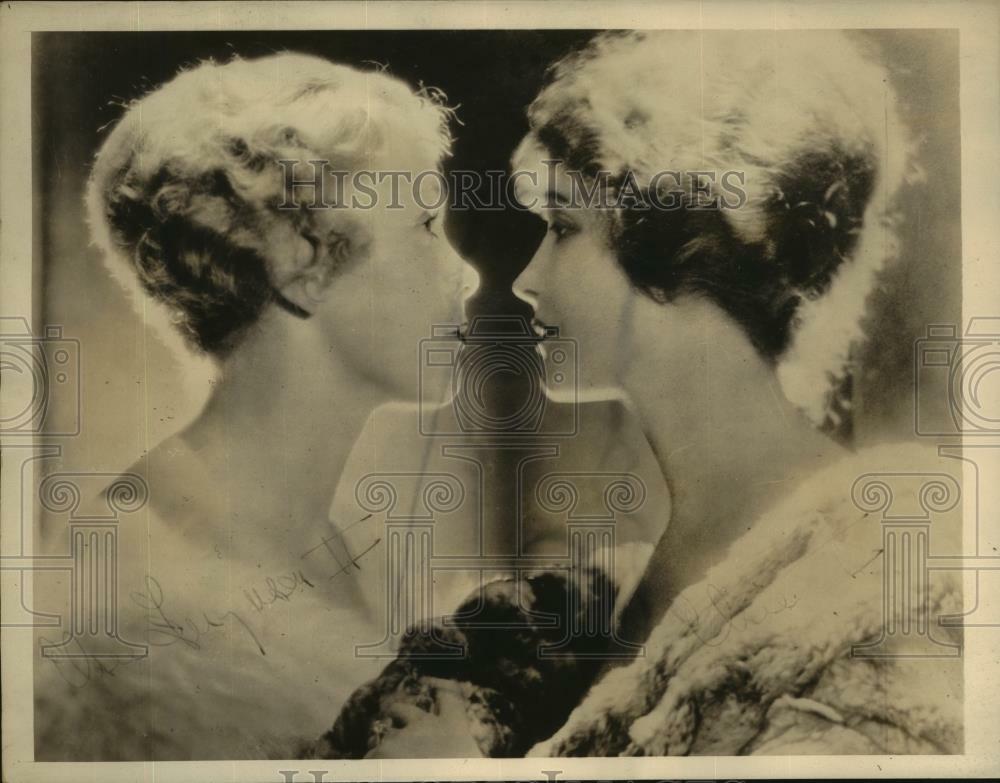
- Ferguson and namesake niece, 1933
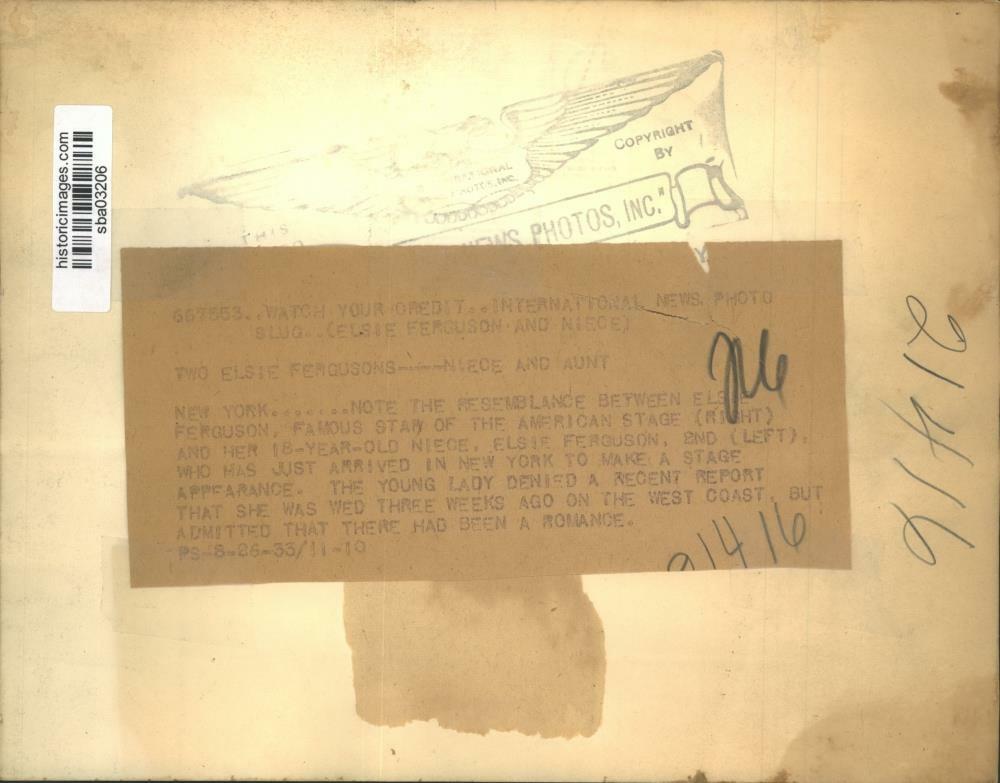
- back Ferguson and niece 1933
- Broadway Photographs(University of South Carolina)


| International | |
|---|---|
| National | |
| People | |
| Other | |
- 1883 births
- 1961 deaths
- American film actresses
- American silent film actresses
- 19th-century American actresses
- American stage actresses
- Actresses from Manhattan
- People from Old Lyme, Connecticut
- American women in World War I
- 20th-century American actresses
- Paramount Pictures contract players
- Burials at Duck River Cemetery