


Draft:Orthogonal vectors problem
 | Review waiting, please be patient.
This may take 4 months or more, since drafts are reviewed in no specific order. There are 4,489 pending submissions waiting for review.
Where to get help
How to improve a draft
You can also browse Wikipedia:Featured articles and Wikipedia:Good articles to find examples of Wikipedia's best writing on topics similar to your proposed article. Improving your odds of a speedy review To improve your odds of a faster review, tag your draft with relevant WikiProject tags using the button below. This will let reviewers know a new draft has been submitted in their area of interest. For instance, if you wrote about a female astronomer, you would want to add the Biography, Astronomy, and Women scientists tags. Editor resources
Reviewer tools
|
 Comment: In accordance with Wikipedia's Conflict of interest guideline, I disclose that I have a conflict of interest regarding the subject of this article. EricNohara (talk) 20:26, 22 April 2026 (UTC)
In computational complexity theory, the Orthogonal Vectors (OV) problem is a fundamental problem that is used to prove conditional lower bounds under the assumption that the Strong Exponential Time Hypothesis (SETH) holds[1]. OV is often used as an intermediate problem in fine grained reductions, transferring conditional hardness from SAT under the SETH. The problem takes as input two sets of binary vectors (vectors in which every entry is either 0 or 1) and outputs whether or not there exists at least one pair of orthogonal vectors, one from each set. By the definition of orthogonality, this is equivalent to asking if the dot product of the two vectors is zero.
Problem definition
[edit]The input to the Orthogonal Vectors problem are two sets of binary vectors, each of some dimension :


.

The Orthogonal Vectors problem asks whether there exists at least one pair of orthogonal vectors, one from each set. More formally, OV returns TRUE if and only if there exists some vectors and such that:


Example
[edit]
Consider the following input sets:
.

For all vectors and , we check if the pair of vectors and are orthogonal by evaluating their dot products :


There exists one pair of orthogonal vectors, so the solution for these particular input sets is TRUE.
Known algorithms
[edit]The straightforward algorithm for solving OV checks all pairs of vectors from the two input sets. For each pair , compute the dot product of in time where is the dimension of the vectors. This algorithm yields a running time of , with the quadradic dependence on dominating the runtime.[1]
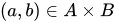


However, under certain constraints on the dimension , faster algorithms are known.
| Dimensionality Constraint | Runtime | Technique |
|---|---|---|
| General case | Pairwise dot product[2] | |
| Small dimension | Enumerating all vectors in [2] | |
| Small dimension with preprocessing | Precompute disjointness structure[3] | |
| , for all constants | Monte Carlo randomized algorithm[4] | |
| General case (recent work) | Equality-matrix decomposition[2] |


As the dimension increases, the performance of all of these algorithms excluding the pairwise dot product algorithm deteriorates. This is due to the bit-parallel and combinatorial techniques used by these algorithms become ineffective as the dimensionality of the vectors increases. Particularly, for sufficiently large , all known algorithms require near quadratic time in the number of vectors[5]. There is no known algorithm running in time for any constant and for all values of where . The existence of such an algorithm would refute the Orthogonal Vectors Conjecture.[2]


The Orthogonal Vectors Conjecture (OVC)
[edit]The Orthogonal Vectors Conjecture (OVC) formalizes the previously mentioned hardness of the OV problem. OVC states that for vectors of dimension for any constant , OV cannot be solved in for any constant [6] The conjecture is widely believed to be true and is closely related to the Strong Exponential Time Hypothesis.

Connection to SETH
[edit]
The connection between Orthogonal vectors and SETH stems from reductions that encode instances of the Boolean satisfiability problem as sets of vectors. At a high level, a Boolean formula can be written as two sets of binary vectors such that a satisfying assignment exists if and only if there exists a pair of orthogonal vectors.
The variables of the Boolean formula are partitioned into two groups and partial assignments are encoded to each group as vectors. The coordinates of these vectors represent whether a partial assignment satisfies particular clauses in the formula. Two vectors are orthogonal if and only if the corresponding partial assignments are consistent and satisfy all clauses[7].
As a result of this reduction, the Orthogonal Vectors problem is strongly connected to the Strong Exponential Time Hypothesis (SETH). Specifically, if the problem on vectors can be solved in time for some constant , then SAT could be solved in time for some , contradicting SETH.[7]


Role in fine-grained complexity
[edit]The Orthogonal Vectors problem serves as a source of hardness in fine-grained complexity. Instead of reducing a problem directly from SAT, many problems are shown to be hard by reducing from OV, which establishes lower bounds under the assumption that SETH holds. Thus, proving that a problem is at least as hard is OV implies that a faster algorithm for that problem would contradict SETH, making the existence of one impossible if SETH holds.[8]
References
[edit]- ^ a b Abboud, Amir; Bringmann, Karl; Dell, Holger; Nederlof, Jesper (2018-06-20). "More consequences of falsifying SETH and the orthogonal vectors conjecture". Proceedings of the 50th Annual ACM SIGACT Symposium on Theory of Computing. STOC 2018. New York, NY, USA: Association for Computing Machinery: 253–266. doi:10.1145/3188745.3188938. ISBN 978-1-4503-5559-9.
- ^ a b c d "The Society for Industrial and Applied Mathematics". The Society for Industrial and Applied Mathematics. doi:10.1137/24M1718299?casa_token=8sJ1sDmyxtwAAAAA:s3II4u7nOmQvrZkZX4ZAybVW9RPhlE22PBKrCiCFfyHZDVu4m_pQdH5_NBSN7ES-FCVR9FXh-EH9. Retrieved 2026-05-02.
- ^ "Pairwise comparison of bit vectors". Theoretical Computer Science Stack Exchange. Retrieved 2026-05-02.
- ^ Abboud, Amir; Williams, Ryan; Yu, Huacheng (2014-12-22), "More Applications of the Polynomial Method to Algorithm Design", Proceedings of the 2015 Annual ACM-SIAM Symposium on Discrete Algorithms (SODA), Proceedings, Society for Industrial and Applied Mathematics, pp. 218–230, doi:10.1137/1.9781611973730.17, ISBN 978-1-61197-374-7, retrieved 2026-05-02
- ^ Chan, Timothy M.; Williams, Ryan (2015-12-21), "Deterministic APSP, Orthogonal Vectors, and More: Quickly Derandomizing Razborov-Smolensky", Proceedings of the 2016 Annual ACM-SIAM Symposium on Discrete Algorithms (SODA), Proceedings, Society for Industrial and Applied Mathematics, pp. 1246–1255, doi:10.1137/1.9781611974331.ch87, retrieved 2026-05-02
- ^ "The Society for Industrial and Applied Mathematics". The Society for Industrial and Applied Mathematics. doi:10.1137/1.9781611973402.135. Retrieved 2026-05-02.
- ^ a b Meneses-Cime, Karina (June 2018). The Intractability And The Tractability Of The Orthogonal Vectors Problem.
- ^ Kush, Deepanshu. Orthogonal Vectors and Related Problems.