


Draft:Nitin Wormhole Framework
The subject is contrary to the purpose of Wikipedia. Rejected by Ldm1954 2 months ago. Last edited by Ldm1954 2 months ago. |  |
 Comment: This is the page creator's unpublished work. This is not the purpose of Wikipedia, this material can be submitted to a journal. Ldm1954 (talk) 12:41, 21 May 2026 (UTC)
| Field | General relativity, Theoretical physics, Quantum gravity |
|---|
The Nitin Wormhole Framework (NWF) is a theoretical physics framework proposed in 2026 by Nitin Raj of Patna, Bihar, India. The framework presents a unified master metric and throat-stabilisation condition for traversable wormholes connecting two distinct spacetime manifolds, interpreted as separate universes.
The framework synthesises six foundational results in theoretical physics — the Schwarzschild metric (1916),[1] the Einstein field equations with cosmological constant (1915, 1917),[2][3] the Morris–Thorne traversable wormhole metric (1988),[4] the Casimir effect (1948),[5] and observed dark energy cosmology (1998–1999)[6][7] — into a single metric and a falsifiable stabilisation inequality.
Its two principal original contributions are a Planck-length-damped redshift function that eliminates the event horizon at the wormhole throat without violating asymptotic flatness, and the Nitin Stability Condition, under which the combined negative-pressure contributions of cosmological dark energy and local Casimir vacuum energy are proposed to satisfy the null energy condition (NEC) violation required at the throat, removing the need for any unobserved exotic matter.
As of 2026 the framework is a theoretical conjecture. Its master metric has not been independently verified against the full Einstein field equations, and no experimental evidence for the predicted wormhole geometry has been reported.
Historical context
[edit]Wormholes in general relativity
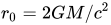
[edit]The mathematical possibility of shortcuts through spacetime arises from Albert Einstein's general theory of relativity (1915).[2] The Schwarzschild metric, derived by Karl Schwarzschild in 1916, is the first exact solution to the Einstein field equations and describes the exterior geometry of a spherically symmetric, non-rotating mass :[1]


where the Schwarzschild radius defines the event horizon, is the gravitational constant, and is the speed of light.


In 1935, Einstein and Rosen demonstrated that the maximally extended Schwarzschild solution contains a bridge structure — the Einstein–Rosen bridge — linking two exterior spacetime sheets.[8] The complete structure of this extension was established independently by Kruskal (1960) and Szekeres (1960),[9] who showed the maximally extended geometry contains four regions: two exterior universes (Regions I and IV), a black hole interior (Region II), and a white hole interior (Region III). The bridge connecting Regions I and IV is non-traversable in classical general relativity.
Morris–Thorne traversable wormholes
[edit]Morris and Thorne (1988) reformulated the wormhole problem by specifying the conditions a geometry must satisfy to permit traversal by a human traveller.[4] Their general static, spherically symmetric metric is:

where is the redshift function (finite everywhere, ensuring no event horizon) and is the shape function (defining the wormhole geometry, with at the throat). Morris and Thorne showed that traversability necessarily requires violation of the null energy condition at the throat:


where is the energy density and the radial pressure. This condition demands exotic matter — a matter field with negative energy density — which has not been observed as a classical field. Identifying a physical source of this NEC violation has been the central open problem in traversable wormhole physics since 1988.


Dark energy and the Casimir effect as NEC-violating sources
[edit]Two observed physical phenomena are known to produce the type of negative pressure or negative energy density required by the Morris–Thorne condition.
The dark energy component of the universe, inferred from the observed accelerating cosmic expansion,[6][7] has an equation of state , corresponding to negative pressure . Its measured energy density, from Planck satellite data,[10] is approximately .


The Casimir effect, predicted by Hendrik Casimir (1948)[5] and experimentally confirmed by Sparnaay (1958)[11] and Lamoreaux (1997),[12] produces a measurable negative energy density between two closely spaced conducting surfaces at separation :


where is the reduced Planck constant. This constitutes a directly observed, laboratory-confirmed violation of the NEC.

Prior to the Nitin Wormhole Framework, Kuhfittig (2014)[13] studied wormholes supported by dark energy, and Garattini and Lobo (2007)[14] demonstrated the mathematical consistency of Casimir-supported wormholes. Neither work combined both sources into a single unified stability condition.
Framework
[edit]Shape function
[edit]The Nitin Wormhole Framework identifies the wormhole throat radius with the Schwarzschild radius of the source mass:

The shape function proposed by the framework is:

Verification against the Morris–Thorne conditions:
| Condition | Expression | Result |
|---|---|---|
| Throat | Satisfied | |
| Flare-out | Satisfied | |
| Asymptotic flatness | as | Satisfied |


Planck-damped redshift function
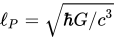
[edit]A central original element of the framework is a novel redshift function motivated by quantum gravity corrections at the Planck length :


The corresponding metric time component is:

This function has the following properties:
- It is finite for all , ensuring no event horizon forms at any radius.
- At macroscopic scales (), , recovering asymptotic flatness.
- At the throat , the gravitational time dilation factor is for any macroscopic , producing negligible time dilation.
- The correction encodes Planck-scale quantum gravitational effects in the minimal possible form consistent with dimensional analysis.


Master metric
[edit]The Nitin Wormhole master metric is obtained by substituting the shape function and redshift function into the Morris–Thorne metric:

where is determined by the source mass and is a universal constant. The metric contains no free parameters beyond standard physical constants and the source mass .
Nitin Stability Condition
[edit]The Nitin Stability Condition is the central quantitative result of the framework. It states that the wormhole throat requires no exotic matter if and only if:

where:
- is the observed cosmological dark energy density
- is the Hubble radius
- is a dimensionless geometric coupling parameter of order unity
- is the Casimir energy density at throat scale
- is the stress–energy tensor projected along null vectors at the throat, representing the tidal stress to be overcome


The left-hand side represents the total available negative-pressure stabilisation budget from observed physics. The right-hand side is the geometric stress of the wormhole that tends to close the throat. The condition is falsifiable: if the Einstein tensor of the master metric cannot be matched to dark energy and Casimir sources satisfying this inequality, the framework is ruled out.
Predictions
[edit]Critical throat radius
[edit]Setting the Casimir term equal to the geometric stress yields a critical throat radius below which Casimir energy alone provides sufficient stabilisation:

For , the dark energy term must contribute. For macroscopic throats the Casimir term is negligible and dark energy enhancement dominates.

Minimum mass for human traversal
[edit]Applying the Morris–Thorne tidal acceleration constraint[4] for a human traveller of height subject to a maximum tidal acceleration of :


This requires a source mass of at least approximately 200 solar masses.
Transit time
[edit]For traversal velocity through a throat of radius , the proper transit time is approximately:


This gives approximately 20 microseconds for a solar-mass throat () and approximately 7 seconds for a human-traversable throat.

Numerical summary
[edit]| Throat type | Casimir density (kg m−3) | Dominant stabiliser | |
|---|---|---|---|
| Planck-scale | Casimir | ||
| Micro | Both | ||
| Solar mass | Dark energy | ||
| Human-traversable | negligible | Dark energy |


Interuniversal topology
[edit]The framework interprets the two causally disconnected exterior regions of the Kruskal–Szekeres maximal extension — Region I and Region IV — as two physically distinct universes, Universe A and Universe B, connected by the wormhole throat at .
From the perspective of Universe A, the wormhole entrance behaves as a black hole: matter can fall inward through . From the perspective of Universe B, the exit behaves as a white hole: matter can only emerge. The master metric continuously describes the geometry from the exterior of Universe A, through the throat, to the exterior of Universe B, with the single parameter governing the entire structure.
This interpretation is consistent with the ER=EPR conjecture of Maldacena and Susskind (2013),[15] which proposes that Einstein–Rosen bridges and Einstein–Podolsky–Rosen entangled pairs are the same geometric phenomenon.
Relation to prior work
[edit]| Component | Prior source | NWF contribution |
|---|---|---|
| Schwarzschild geometry at throat | Schwarzschild (1916)[1] | Identification |
| Morris–Thorne metric structure | Morris & Thorne (1988)[4] | Explicit and |
| Dark energy as wormhole support | Kuhfittig (2014)[13] | Unified with Casimir in single condition |
| Casimir wormhole support | Garattini & Lobo (2007)[14] | Combined with dark energy; throat scale |
| Planck-damped redshift function | None identified | Original contribution |
| Unified stability inequality | None identified | Original contribution |

Limitations
[edit]The following aspects of the framework had not been independently established as of 2026:
- The Einstein tensor of the master metric has not been computed in closed form and compared against the proposed stress–energy sources via the Einstein field equations.
- The dark energy geometric enhancement factor is a phenomenological model; no first-principles derivation of the coupling mechanism has been given.
- Dynamic stability of the throat against small perturbations has not been analysed.
- No wormhole formation mechanism from ordinary astrophysical initial conditions is proposed.
- The Casimir calculation assumes idealised perfectly conducting boundary conditions at the throat, which may not apply at macroscopic scales.
- The framework has not been submitted to a peer-reviewed journal as of 2026.

See also
[edit]References
[edit]- 1 2 3 Schwarzschild, K. (1916). "Über das Gravitationsfeld eines Massenpunktes nach der Einsteinschen Theorie". Sitzungsberichte der Königlich Preußischen Akademie der Wissenschaften. pp. 189–196.
- 1 2 Einstein, A. (1915). "Die Feldgleichungen der Gravitation". Sitzungsberichte der Preußischen Akademie der Wissenschaften. pp. 844–847.
- ↑ Einstein, A. (1917). "Kosmologische Betrachtungen zur allgemeinen Relativitätstheorie". Sitzungsberichte der Preußischen Akademie der Wissenschaften. pp. 142–152.
- 1 2 3 4 Morris, M. S.; Thorne, K. S. (1988). "Wormholes in spacetime and their use for interstellar travel: A tool for teaching general relativity". American Journal of Physics. 56 (5): 395–412. doi:10.1119/1.15620
- 1 2 Casimir, H. B. G. (1948). "On the attraction between two perfectly conducting plates". Proceedings of the Koninklijke Nederlandse Akademie van Wetenschappen. 51: 793–795.
- 1 2 Riess, A. G.; et al. (1998). "Observational Evidence from Supernovae for an Accelerating Universe and a Cosmological Constant". The Astronomical Journal. 116 (3): 1009–1038. doi:10.1086/300499
- 1 2 Perlmutter, S.; et al. (1999). "Measurements of Omega and Lambda from 42 High-Redshift Supernovae". The Astrophysical Journal. 517 (2): 565–586. doi:10.1086/307221
- ↑ Einstein, A.; Rosen, N. (1935). "The Particle Problem in the General Theory of Relativity". Physical Review. 48 (1): 73–77. doi:10.1103/PhysRev.48.73
- ↑ Kruskal, M. D. (1960). "Maximal Extension of Schwarzschild Metric". Physical Review. 119 (5): 1743–1745. doi:10.1103/PhysRev.119.1743
- ↑ Planck Collaboration; Aghanim, N.; et al. (2020). "Planck 2018 results. VI. Cosmological parameters". Astronomy & Astrophysics. 641: A6. doi:10.1051/0004-6361/201833910
- ↑ Sparnaay, M. J. (1958). "Measurements of attractive forces between flat plates". Physica. 24 (6–10): 751–764.
- ↑ Lamoreaux, S. K. (1997). "Demonstration of the Casimir Force in the 0.6 to 6 μm Range". Physical Review Letters. 78 (1): 5–8. doi:10.1103/PhysRevLett.78.5
- 1 2 Kuhfittig, P. K. F. (2014). "Wormholes supported by dark energy". Physical Review D. 90 (12): 124048. doi:10.1103/PhysRevD.90.124048
- 1 2 Garattini, R.; Lobo, F. S. N. (2007). "Self-sustained traversable wormholes in noncommutative geometry". Physics Letters B. 671 (1): 146–152. doi:10.1016/j.physletb.2008.11.064
- ↑ Maldacena, J.; Susskind, L. (2013). "Cool horizons for entangled black holes". Fortschritte der Physik. 61 (9): 781–811. doi:10.1002/prop.201300020
Further reading
[edit]- Visser, M. (1995). Lorentzian Wormholes: From Einstein to Hawking. AIP Press, Woodbury, New York. ISBN 978-1563966538
- Morris, M. S.; Thorne, K. S.; Yurtsever, U. (1988). "Wormholes, Time Machines, and the Weak Energy Condition". Physical Review Letters. 61 (13): 1446–1449. doi:10.1103/PhysRevLett.61.1446
- Ford, L. H.; Roman, T. A. (1996). "Quantum field theory constrains traversable wormhole geometries". Physical Review D. 53 (10): 5496–5507. doi:10.1103/PhysRevD.53.5496
- Weinberg, S. (1989). "The cosmological constant problem". Reviews of Modern Physics. 61 (1): 1–23. doi:10.1103/RevModPhys.61.1
Category:General relativity Category:Theoretical physics Category:Quantum gravity Category:Dark energy Category:2026 in science Category:Indian physicists