


Draft:Linnik class
 | Review waiting, please be patient.
This may take 4 months or more, since drafts are reviewed in no specific order. There are 4,488 pending submissions waiting for review.
Where to get help
How to improve a draft
You can also browse Wikipedia:Featured articles and Wikipedia:Good articles to find examples of Wikipedia's best writing on topics similar to your proposed article. Improving your odds of a speedy review To improve your odds of a faster review, tag your draft with relevant WikiProject tags using the button below. This will let reviewers know a new draft has been submitted in their area of interest. For instance, if you wrote about a female astronomer, you would want to add the Biography, Astronomy, and Women scientists tags. Editor resources
Reviewer tools
|
The Linnik class is one of the central concepts in the arithmetic of probability distributions. Following Yuri Vladimirovich Linnik, denote by the class of distributions that have no indecomposable divisors. Examples of distributions belonging to the class include normal distributions (Cramér's theorem), Poisson distributions (Raikov's theorem), as well as their convolutions (Linnik's theorem). Let . Then, according to Khinchin's second theorem, the distribution is infinitely divisible. Hence, by the Lévy formula, its characteristic function can be represented in the form


where , , and is a Borel measure on satisfying the condition


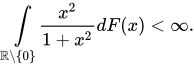
The measure is called the Lévy spectral measure of the infinitely divisible distribution . The central problem in the arithmetic of probability distributions is to determine conditions on and that are necessary and sufficient for an infinitely divisible distribution to belong to the class . Denote by the class of infinitely divisible distributions having the property that the Lévy spectral measure in (1) is discrete and concentrated on a set of the form


where , , and the numbers , , , are natural numbers different from 1.



Linnik's theorem on the class
[edit]Let be an infinitely divisible distribution and suppose that in formula (1), . If , then [1]. Note that there exist distributions belonging to the class but not to . A corresponding example was constructed in [2]. On the other hand, under the additional assumption of rapid decay of the quantity as , membership in the class implies membership in the class [3].


Membership in the class of generalized Poisson distributions
[edit]We present two results concerning membership in the class of a generalized Poisson distribution, i.e., an infinitely divisible distribution such that in (1), and the Lévy spectral measure is completely finite.

Theorem 1[4]. Suppose that in (1), , the Lévy spectral measure is finite and concentrated on the interval , where . Then .


Theorem 2[5]. Suppose that in (1), , the Lévy spectral measure is finite and concentrated on a set of independent points. Then .
Properties of the class as a subset of the class of all infinitely divisible distributions
[edit]1. The class is dense (in the weak topology) in the class of all infinitely divisible distributions[6].
2. Any infinitely divisible distribution can be represented as a finite or countable convolution of distributions belonging to the class [4].
References
[edit]- ^ Linnik, Yu. V. General theorems on the decomposition of infinitely divisible laws. I // Theory of Probability and Its Applications. — 1958. — Vol. 3, No. 1. — P. 3–40.
- ^ Goldberg, A. A.; Ostrovskii, I. V. Application of W. K. Hayman's theorem to a problem in the theory of decomposition of probability laws // Ukrainian Mathematical Journal. — 1967. — Vol. 19, No. 3. — P. 104–106.
- ^ Linnik, Yu. V.; Ostrovskii, I. V. Decomposition of Random Variables and Vectors. — Moscow: Nauka, 1972.
- ^ a b Ostrovskii, I. V. On decompositions of infinitely divisible laws without a Gaussian component // Doklady Akademii Nauk SSSR. — 1965. — Vol. 161, No. 1. — P. 48–51.
- ^ Cuppens, R. Ensembles indépendants et décomposition des fonctions caractéristiques // C. R. Acad. Sci. Paris, Série A-B. — 1971. — Vol. 272. — P. A1464–A1466.
- ^ Ostrovskii, I. V. On certain classes of infinitely divisible laws // Izvestiya Akademii Nauk SSSR, Seriya Matematicheskaya. — 1970. — Vol. 34, No. 4. — P. 923–944.