Cloudflare fetched the original article and streamed it through HTMLRewriter to apply an entirely new visual system without rebuilding the source page.
// request.cf · coarse context
A page that knows where it met you.
Only coarse request metadata is shown. This demo does not display or persist visitor IP addresses.
Reliable sources include: reputable newspapers, magazines, academic journals, and books from respected publishers.
Unacceptable sources include: personal blogs, social media, predatory publishers, most tabloids, and websites where anyone can contribute.
Replace any unreliable sources with high-quality sources. If you cannot find a reliable source for the material, it should be removed.
This draft's references do not show that the subject meets Wikipedia's criteria for inclusion. The draft requires multiple published secondary sources that:
provide significant coverage: discuss the subject in detail, not just brief mentions or routine announcements;
are reliable: from reputable outlets with editorial oversight;
are independent: not connected to the subject, such as interviews, press releases, the subject's own website, or sponsored content.
Please add references that meet all three of these criteria. If none exist, the subject is not yet suitable for Wikipedia.
If you would like to continue working on the submission, click on the "Edit" tab at the top of the window.
If you have not resolved the issues listed above, your draft will be declined again and potentially deleted.
If you need extra help, please ask us a question at the AfC Help Desk or get live help from experienced editors.
Please do not remove reviewer comments or this notice until the submission is accepted.
Where to get help
If you need help editing or submitting your draft, please ask us a question at the AfC Help Desk or get live help from experienced editors. These venues are only for help with editing and the submission process, not to get reviews.
If you need feedback on your draft, or if the review is taking a lot of time, you can try asking for help on the talk page of a relevant WikiProject. Some WikiProjects are more active than others so a speedy reply is not guaranteed.
To improve your odds of a faster review, tag your draft with relevant WikiProject tags using the button below. This will let reviewers know a new draft has been submitted in their area of interest. For instance, if you wrote about a female astronomer, you would want to add the Biography, Astronomy, and Women scientists tags.
This draft's references do not show that the subject meets Wikipedia's criteria for inclusion. The draft requires multiple published secondary sources that:
provide significant coverage: discuss the subject in detail, not just brief mentions or routine announcements;
are reliable: from reputable outlets with editorial oversight;
are independent: not connected to the subject, such as interviews, press releases, the subject's own website, or sponsored content.
Please add references that meet all three of these criteria. If none exist, the subject is not yet suitable for Wikipedia.
Comment: More reliable sources needed to establish notability (like where else this concept has been used) EvanTech10 (talk, contribs) ⚡ 21:21, 5 August 2026 (UTC)
Comment: Not sourced for notability (and nor is Conway for that matter). ChrysGalley (talk) 14:31, 26 April 2026 (UTC)
Notation for very large numbers
Array Notation is a means of expressing extremely large numbers, created by Jonathan Bowers[1][2], vastly exceeding Conway chained arrow notation, a notation designed to produce very large numbers [3] (see Bird's proof).[4][5][6]
Let denote positive integers and denote an arbitrary sequence of positive integers. An entry is a positive integer in an array. An example of a valid array is . The array is evaluated according to the following rules:
(if the third entry is , all entries before the last preceding non- entry become the first entry, the last of the ones becomes the original array with the second entry decreased by , and the said non- entry is decreased by )
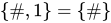
Bird's Proof is a theorem that states that in Conway chained arrow notation. The theorem was proven by Chris Bird and named by Jonathan Bowers.[4][2]
Before proving the main theorem, Bird proved two lemmas:
Conway chains.
(’s on each side)
and two corollaries:
(’s on each side), .
(’s on each side), .
Note that the second corollary is just the first corollary, but with .
Bowers created a simple function: ( array of ) . As one might expect, this grows extraordinarily faster than Conway chained arrow notation. ( in the fast-growing hierarchy[7])
denote remainders of an array, denotes the "array of" operator, denotes a "separator" and denote separators such that .
The rules only cover cases up to , but can be easily extended to :[2]
2 entries:
Rows ending with 1:
Second entry is 1:
Third entry is 1, non-1 entry in same row
Rules above do not apply:
2 entries on main row, next non-1 entry begins a higher structure:
2 entries on main row, next non-1 entry is preceded by 1's in its row: [2]


 Comment: More reliable sources needed to establish notability (like where else this concept has been used) EvanTech10 (talk, contribs) ⚡ 21:21, 5 August 2026 (UTC)




- Reliable sources include: reputable newspapers, magazines, academic journals, and books from respected publishers.
- Unacceptable sources include: personal blogs, social media, predatory publishers, most tabloids, and websites where anyone can contribute.
Replace any unreliable sources with high-quality sources. If you cannot find a reliable source for the material, it should be removed.