


Double integrator

In systems and control theory, the double integrator is a canonical example of a second-order control system.[1] It models the dynamics of a simple mass in one-dimensional space under the effect of a time-varying force input .

Differential equations
[edit]The differential equations which represent a double integrator are:


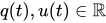
where both . Let us now represent this in state space form with the vector

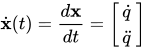
In this representation, it is clear that the control input is the second derivative of the output . In the scalar form, the control input is the second derivative of the output .


State space representation
[edit]The normalized state space model of a double integrator takes the form
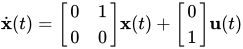

According to this model, the input is the second derivative of the output , hence the name double integrator.

Transfer function representation
[edit]Taking the Laplace transform of the state space input-output equation, we see that the transfer function of the double integrator is given by

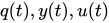
Using the differential equations dependent on and , and the state space representation:

References
[edit]- ↑ Venkatesh G. Rao and Dennis S. Bernstein (2001). "Naive control of the double integrator" (PDF). IEEE Control Systems Magazine. Retrieved 2012-03-04.