


Displacement operator
In the quantum mechanics study of optical phase space, the displacement operator for one mode is the shift operator in quantum optics,
- ,

where is the amount of displacement in optical phase space, is the complex conjugate of that displacement, and and are the lowering and raising operators, respectively.


The name of this operator is derived from its ability to displace a localized state in phase space by a magnitude . It may also act on the vacuum state by displacing it into a coherent state. Specifically, where is a coherent state, which is an eigenstate of the annihilation (lowering) operator. This operator was introduced independently by Richard Feynman and Roy J. Glauber in 1951.[1][2][3]


Properties
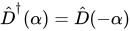
[edit]The displacement operator is a unitary operator, and therefore obeys , where is the identity operator. Since , the hermitian conjugate of the displacement operator can also be interpreted as a displacement of opposite magnitude (). The effect of applying this operator in a similarity transformation of the ladder operators results in their displacement.





The product of two displacement operators is another displacement operator whose total displacement, up to a phase factor, is the sum of the two individual displacements. This can be seen by utilizing the Baker–Campbell–Hausdorff formula.

which shows us that:

When acting on an eigenket, the phase factor appears in each term of the resulting state, which makes it physically irrelevant.[4]

It further leads to the braiding relation

Alternative expressions
[edit]The Kermack–McCrea identity (named after William Ogilvy Kermack and William McCrea) gives two alternative ways to express the displacement operator:


In the Cahill-Glauber -order representation we can write some useful definitions of these forms of the displacement operator.


With the generalization: [5]

Relationship to the Symmetric Delta Function
[edit]The displacement operator is the fourier transform of the symmetric delta function

This is extended to the generally ordered delta function: [6]

Example: Normal ordered delta function
![{\displaystyle {\begin{aligned}{\hat {T}}_{+1}(\alpha )&=\int {\frac {d^{2}\beta }{\pi }}{\hat {D}}_{+1}(\beta )e^{\beta ^{*}\alpha -\beta \alpha ^{*}}\\&=\int {\frac {d^{2}\beta }{\pi }}e^{{\hat {a}}^{\dagger }\beta }e^{-{\hat {a}}\beta ^{*}}e^{\beta ^{*}\alpha -\beta \alpha ^{*}}\\&=\int {\frac {d^{2}\beta }{\pi }}e^{({\hat {a}}^{\dagger }-\alpha ^{*})\beta }e^{(\alpha -{\hat {a}})\beta ^{*}}\\&={\frac {1}{\pi }}\left[\pi \delta ^{(1)}({\hat {a}}^{\dagger }-\alpha ^{*})\right]\left[\pi \delta ^{(1)}({\hat {a}}-\alpha )\right]\\&=\pi \delta _{+1}^{(2)}({\hat {a}}-\alpha ,{\hat {a}}^{\dagger }-\alpha ^{*})\end{aligned}}}](https://wikimedia.org/api/rest_v1/media/math/render/svg/491a13face19be4f0b1d81b77af93863ad74c4cd)
Multimode displacement
[edit]The displacement operator can also be generalized to multimode displacement. A multimode creation operator can be defined as
- ,
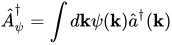
where is the wave vector and its magnitude is related to the frequency according to . Using this definition, we can write the multimode displacement operator as


- ,

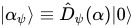
and define the multimode coherent state as
- .
See also
[edit]References
[edit]- ↑ Dodonov, V. V. (2002). "'Nonclassical' states in quantum optics: a 'squeezed' review of the first 75 years". Journal of Optics B: Quantum and Semiclassical Optics. 4 (1).
- ↑ Feynman, Richard P. (1951-10-01). "An Operator Calculus Having Applications in Quantum Electrodynamics". Physical Review. 84 (1): 108–128. doi:10.1103/PhysRev.84.108.
- ↑ Glauber, Roy J. (1951-11-01). "Some Notes on Multiple-Boson Processes". Physical Review. 84 (3): 395–400. doi:10.1103/PhysRev.84.395.
- ↑ Christopher Gerry and Peter Knight: Introductory Quantum Optics. Cambridge (England): Cambridge UP, 2005.
- ↑ Cahill, K. E.; Glauber, R. J. (1969-01-25). "Density Operators and Quasiprobability Distributions". Physical Review. 177 (5): 1882–1902. doi:10.1103/physrev.177.1882.
- ↑ Cahill, K. E.; Glauber, R. J. (1969-01-25). "Density Operators and Quasiprobability Distributions". Physical Review. 177 (5): 1882–1902. doi:10.1103/physrev.177.1882.