


Discrete orthogonal polynomials
In mathematics, a sequence of discrete orthogonal polynomials is a sequence of polynomials that are pairwise orthogonal with respect to a discrete measure. Examples include the discrete Chebyshev polynomials, Charlier polynomials, Krawtchouk polynomials, Meixner polynomials, dual Hahn polynomials, Hahn polynomials, and Racah polynomials.
If the measure has finite support, then the corresponding sequence of discrete orthogonal polynomials has only a finite number of elements. The Racah polynomials give an example of this.
Definition
[edit]Consider a discrete measure on some set with weight function .



A family of orthogonal polynomials is called discrete if they are orthogonal with respect to (resp. ), i.e.,



where is the Kronecker delta.[1]

Remark
[edit]Any discrete measure is of the form
- ,
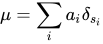
so one can define a weight function by .

Literature
[edit]- Baik, Jinho; Kriecherbauer, T.; McLaughlin, K. T.-R.; Miller, P. D. (2007), Discrete orthogonal polynomials. Asymptotics and applications, Annals of Mathematics Studies, vol. 164, Princeton University Press, ISBN 978-0-691-12734-7, MR 2283089
References
[edit]- ↑ Arvesú, J.; Coussement, J.; Van Assche, Walter (2003). "Some discrete multiple orthogonal polynomials". Journal of Computational and Applied Mathematics. 153: 19–45.