


Deslanges trisectrix

The Deslanges trisectrix (sometimes also spelled Delanges) is a curve belonging to the family of Deslanges sectrices, named after the Italian engineer and mathematician Paolo Deslanges (c. 1750–1810), who studied them in 1783.[1] Like other trisectrix curves, it can be used as an auxiliary tool to perform angle trisection with a straightedge and compass, although the use of such auxiliary tools is outside the admissible methods of classical geometry.
Geometric definition
[edit]
The geometric construction of the Deslanges trisectrix is based on a circle centered at the origin O, such that the points of the trisectrix form the locus determined by the intersection of two families of lines:
- Radial lines from the origin forming an angle of with the x-axis.
- Horizontal lines drawn from the intersection points of the circle and rays forming an angle of with the x-axis.


According to the diagram,[1] to determine a point P, two radii are drawn: OP1 (at angle ) and OP2 (at angle ). From point P1 (the intersection of the first radius and the circle), a line parallel to the x-axis is drawn, which intersects the ray OP2 at point P.
Equations
[edit]According to the geometric definition, the polar equation is of the form:
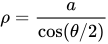
An equivalent form of the equation in polar coordinates uses the secant function to write the expression compactly:[2] (where is a parameter to orient the curve with respect to the origin of the angles).


In Cartesian coordinates, the equation of the trisectrix is of the form:[1]

Properties
[edit]The Deslanges trisectrix and the folium of Dürer are inverse curves to each other with respect to any circle centered at the common center of symmetry of both curves.
Trisection
[edit]
To determine the trisection of an arbitrary angle , the following construction can be used:
- Draw the circle tangent to the interior of the trisectrix, centered at O with radius a.
- Draw the radius forming an angle of counterclockwise from the positive x-axis, which determines point P2 on the circle.
- Draw the tangent to the circle at P2, which intersects the trisectrix at point P1.
- The angle P1OP2 measures .

Deslanges sectrices
[edit]Generalizing the trisectrix formula for a value other than 2 yields the following expression:[1]

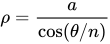
from which Deslanges sectrices of order (for integer ) can be generated.

Gallery
[edit] |
 |
See also
[edit]References
[edit]- 1 2 3 4 "DELANGES TRISECTRIX AND SECTRIX". mathcurve. Retrieved March 17, 2021.
- ↑ Daniel J. Velleman; S. Wagon (2020). Bicycle or Unicycle?: A Collection of Intriguing Mathematical Puzzles. American Mathematical Soc. p. 86. ISBN 9781470447595. Retrieved March 17, 2021.
External links
[edit]
- "DELANGES TRISECTRIX AND SECTRIX". mathcurve. Retrieved March 17, 2021.