


DBAR problem
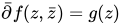
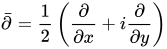
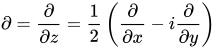
The DBAR problem, or the -problem, is the problem of solving the differential equation for the function , where is assumed to be known and is a complex number in a domain . The operator is called the DBAR operator:[1] The DBAR operator is nothing other than the complex conjugate of the operator denoting the usual differentiation in the complex -plane.




The DBAR problem is of key importance in the theory of integrable systems, Schrödinger operators and (together with a jump condition) generalizes the Riemann–Hilbert problem.[1][2][3]
Citations
[edit]References
[edit]- Ablowitz, Mark J.; Fokas, A. S. (2003). Complex Variables: Introduction and Applications. Cambridge University Press. pp. 516, 598–626. ISBN 978-0-521-53429-1.
- Haslinger, Friedrich (2014). The d-bar Neumann Problem and Schrödinger Operators. Walter de Gruyter GmbH & Co KG. ISBN 978-3-11-031535-6.
- Konopelchenko, B. G. (2000). "On dbar-problem and integrable equations". arXiv:nlin/0002049.
 | This mathematical analysis–related article is a stub. You can help Wikipedia by adding missing information. |