


Cross-correlation matrix
 | This article has multiple issues. Please help improve it or discuss these issues on the talk page. (Learn how and when to remove these messages)
|


| Part of a series on Statistics |
| Correlation and covariance |
|---|
 |
The cross-correlation matrix of two random vectors is a matrix containing as elements the cross-correlations of all pairs of elements of the random vectors. The cross-correlation matrix is used in various digital signal processing algorithms.
Definition
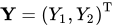
[edit]For two random vectors and , each containing random elements whose expected value and variance exist, the cross-correlation matrix of and is defined by[1]: p.337




![{\displaystyle \operatorname {R} _{\mathbf {X} \mathbf {Y} }\triangleq \ \operatorname {E} [\mathbf {X} \mathbf {Y} ^{\rm {T}}]}](https://wikimedia.org/api/rest_v1/media/math/render/svg/1337f507d7cb6918d742ae2f029e0554013f7a58)
and has dimensions . Written component-wise:

![{\displaystyle \operatorname {R} _{\mathbf {X} \mathbf {Y} }={\begin{bmatrix}\operatorname {E} [X_{1}Y_{1}]&\operatorname {E} [X_{1}Y_{2}]&\cdots &\operatorname {E} [X_{1}Y_{n}]\\\\\operatorname {E} [X_{2}Y_{1}]&\operatorname {E} [X_{2}Y_{2}]&\cdots &\operatorname {E} [X_{2}Y_{n}]\\\\\vdots &\vdots &\ddots &\vdots \\\\\operatorname {E} [X_{m}Y_{1}]&\operatorname {E} [X_{m}Y_{2}]&\cdots &\operatorname {E} [X_{m}Y_{n}]\\\\\end{bmatrix}}}](https://wikimedia.org/api/rest_v1/media/math/render/svg/dfaf0f3923eafd144f762732bbaa951102ed00bb)
The random vectors and need not have the same dimension, and either might be a scalar value.
Example
[edit]For example, if and are random vectors, then is a matrix whose -th entry is .



![{\displaystyle \operatorname {E} [X_{i}Y_{j}]}](https://wikimedia.org/api/rest_v1/media/math/render/svg/e511d6ea021c2d4b0579f621faec897ec52a1999)
Complex random vectors
[edit]If and are complex random vectors, each containing random variables whose expected value and variance exist, the cross-correlation matrix of and is defined by




![{\displaystyle \operatorname {R} _{\mathbf {Z} \mathbf {W} }\triangleq \ \operatorname {E} [\mathbf {Z} \mathbf {W} ^{\rm {H}}]}](https://wikimedia.org/api/rest_v1/media/math/render/svg/b96a25804b6f71adb2dd4366a18cc65e96553d88)
where denotes Hermitian transposition.

Uncorrelatedness
[edit]Two random vectors and are called uncorrelated if
![{\displaystyle \operatorname {E} [\mathbf {X} \mathbf {Y} ^{\rm {T}}]=\operatorname {E} [\mathbf {X} ]\operatorname {E} [\mathbf {Y} ]^{\rm {T}}.}](https://wikimedia.org/api/rest_v1/media/math/render/svg/1a8bb45997c59ac08d38c6073ad03c832d11abf6)
They are uncorrelated if and only if their cross-covariance matrix matrix is zero.

In the case of two complex random vectors and they are called uncorrelated if
![{\displaystyle \operatorname {E} [\mathbf {Z} \mathbf {W} ^{\rm {H}}]=\operatorname {E} [\mathbf {Z} ]\operatorname {E} [\mathbf {W} ]^{\rm {H}}}](https://wikimedia.org/api/rest_v1/media/math/render/svg/e653a5949cb26600c65a6d23c16310eae1e9867f)
and
![{\displaystyle \operatorname {E} [\mathbf {Z} \mathbf {W} ^{\rm {T}}]=\operatorname {E} [\mathbf {Z} ]\operatorname {E} [\mathbf {W} ]^{\rm {T}}.}](https://wikimedia.org/api/rest_v1/media/math/render/svg/500e14ec28154556c9b0aa741d1b036af7b7a67f)
Properties
[edit]Relation to the cross-covariance matrix
[edit]The cross-correlation is related to the cross-covariance matrix as follows:
- Respectively for complex random vectors:
![{\displaystyle \operatorname {K} _{\mathbf {X} \mathbf {Y} }=\operatorname {E} [(\mathbf {X} -\operatorname {E} [\mathbf {X} ])(\mathbf {Y} -\operatorname {E} [\mathbf {Y} ])^{\rm {T}}]=\operatorname {R} _{\mathbf {X} \mathbf {Y} }-\operatorname {E} [\mathbf {X} ]\operatorname {E} [\mathbf {Y} ]^{\rm {T}}}](https://wikimedia.org/api/rest_v1/media/math/render/svg/1d58fc3b03892e013a545da3322c2d4942d7314e)
![{\displaystyle \operatorname {K} _{\mathbf {Z} \mathbf {W} }=\operatorname {E} [(\mathbf {Z} -\operatorname {E} [\mathbf {Z} ])(\mathbf {W} -\operatorname {E} [\mathbf {W} ])^{\rm {H}}]=\operatorname {R} _{\mathbf {Z} \mathbf {W} }-\operatorname {E} [\mathbf {Z} ]\operatorname {E} [\mathbf {W} ]^{\rm {H}}}](https://wikimedia.org/api/rest_v1/media/math/render/svg/e3b852cac5898146e76309d2f9d00ac163d1d65a)
See also
[edit]- Autocorrelation
- Correlation does not imply causation
- Covariance function
- Pearson product-moment correlation coefficient
- Correlation function (astronomy)
- Correlation function (statistical mechanics)
- Correlation function (quantum field theory)
- Mutual information
- Rate distortion theory
- Radial distribution function
References
[edit]- ↑ Gubner, John A. (2006). Probability and Random Processes for Electrical and Computer Engineers. Cambridge University Press. ISBN 978-0-521-86470-1.
Further reading
[edit]- Hayes, Monson H., Statistical Digital Signal Processing and Modeling, John Wiley & Sons, Inc., 1996. ISBN 0-471-59431-8.
- Solomon W. Golomb, and Guang Gong. Signal design for good correlation: for wireless communication, cryptography, and radar. Cambridge University Press, 2005.
- M. Soltanalian. Signal Design for Active Sensing and Communications. Uppsala Dissertations from the Faculty of Science and Technology (printed by Elanders Sverige AB), 2014.