// Workers AI · dad joke modeWhat did the Corryocactus say? "I'm a little prickly.
| Corryocactus | |
|---|---|
 | |
| Corryocactus brevistylus | |
Scientific classification  | |
| Kingdom: | Plantae |
| Clade: | Tracheophytes |
| Clade: | Angiosperms |
| Clade: | Eudicots |
| Order: | Caryophyllales |
| Family: | Cactaceae |
| Subfamily: | Cactoideae |
| Tribe: | Echinocereeae |
| Genus: | Corryocactus Britton & Rose |
| Type species | |
| Corryocactus brevistylus | |
| Species | |
| Synonyms | |
Corryocactus is a genus of cacti found in Bolivia, Peru and northern Chile.
Description
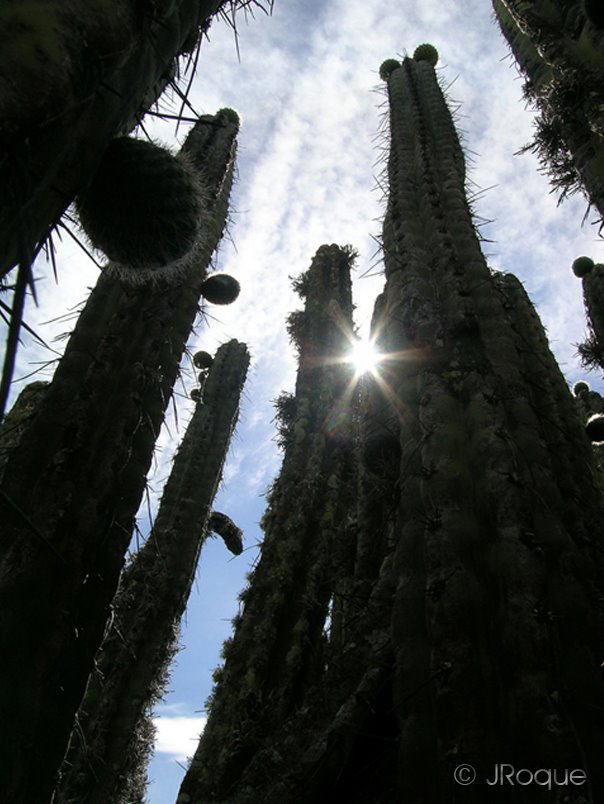
[edit]These plants are characterized by profuse branching from their bases, with fibrous or sometimes tuberous root systems. Their stems, typically 2 to 5 cm thick, exhibit varied growth habits: smaller species are erect, while larger ones are prostrate with upright tips, climbing over vegetation, or initially erect before drooping. One notable species can form columns up to 5 meters tall with stems measuring 10 to 15 cm in diameter. The stems feature typically four to ten ribs that are swollen at the areoles, which are themselves tuberculate and heavily spined. Central spines can be quite long, usually 3 to 5 cm, but occasionally reaching up to 15 cm or even 25 cm. Corryocactus flowers emerge singly from the areoles and open during the day. These flowers have short tubes and bloom widely, ranging from 2 to 10 cm in diameter. The perianth segments display a color spectrum from yellow to orange to red, with variation possible within a single species. Following fertilization, spiny, spherical fruits develop, measuring 3 to 10 cm in diameter. These fruits contain dark brown to black seeds suspended in a juicy pulp.[1]
Distribution
[edit]Most Corryocactus species grow at altitudes between 2000 and 3000 meters, though some can be found in lowlands or ascend to elevations of up to 4000 meters.[2]
Taxonomy
[edit]The genus was described in 1920 by American botanists Nathaniel Lord Britton and Joseph Nelson Rose in their publication The Cactaceae. The name Corryocactus honors Thomas Avery Corry (1862–1942), an engineer for the Peruvian railway company Ferrocarril del Sur, whose work on the newly laid railway line led to the discovery of the first three known species.[3] The genus was formerly placed in the tribe Notocacteae. It has also been placed in the tribe Echinocereeae. A 2011 molecular phylogenetic study excluded the genus from the "core" Echinocereeae, commenting that it lay "outside of a well-supported larger clade in our analysis".[4]
Species
[edit]Species accepted As of January 2026[update] by Plants of the World Online:[5]
| Image | Scientific name | Distribution |
|---|---|---|
 | Corryocactus apiciflorus (Vaupel) Hutchison | Peru |
 | Corryocactus aureus (Meyen) Hutchison | Peru |
 | Corryocactus ayacuchoensis Rauh & Backeb. | Peru |
| Corryocactus ayopayanus Cárdenas | Bolivia | |
 | Corryocactus brachypetalus (Vaupel) Britton & Rose | Bolivia |
 | Corryocactus brevistylus (K.Schum. ex Vaupel) Britton & Rose | Chile, Peru |
| Corryocactus chachapoyensis (Ochoa & Backeb.) Ochoa & Backeb. ex D.R.Hunt | Peru | |
 | Corryocactus dillonii A.Pauca & Quip. | Peru |
 | Corryocactus erectus (Backeb.) F.Ritter | Peru |
 | Corryocactus melanotrichus (K.Schum.) Britton & Rose | Bolivia |
| Corryocactus pulquinensis Cárdenas | Peru | |
| Corryocactus quadrangularis (Rauh & Backeb.) F.Ritter ex D.R.Hunt, N.P.Taylor & G.J.Charles | Peru | |
| Corryocactus serpens F.Ritter | Peru | |
 | Corryocactus squarrosus (Vaupel) Hutchison | Peru |
 | Corryocactus tarijensis Cárdenas | Bolivia |
Synonymy
[edit]The following genera have been brought into synonymy with this genus:
References
[edit]- ↑ Anderson, Edward F.; Eggli, Urs (2005). Das grosse Kakteen-Lexikon (in German). Stuttgart (Hohenheim): Ulmer. p. 144-147. ISBN 3-8001-4573-1.
- ↑ "Tropicos". Tropicos. Retrieved 2026-01-08.
- ↑ Berger, Alwin (1924-07-18). "The Cactaceae, Descriptions and Illustrations of Plants of the Cactus Family . By N. L. Britton and J. N. Rose. The Carnegie Institution of Washington. Vol. I, 1919; Vol. II, 1920; Vol. III, 1922; Vol. IV, 1924". Science. 60 (1542): 66–67. doi:10.1126/science.60.1542.66. ISSN 0036-8075. Retrieved 2026-01-08.
- ↑ Barcenas, Rolando T.; Yesson, Chris & Hawkins, Julie A. (2011), "Molecular systematics of the Cactaceae", Cladistics, 27 (5): 470–489, doi:10.1111/j.1096-0031.2011.00350.x, PMID 34875796
- ↑ "Corryocactus Britton & Rose". Plants of the World Online. 2005-01-01. Retrieved 2026-01-04.
External links
[edit] Media related to Corryocactus at Wikimedia Commons
 Data related to Corryocactus at Wikispecies