


Correlation immunity
In mathematics, the correlation immunity of a Boolean function is a measure of the degree to which its outputs are uncorrelated with some subset of its inputs. Specifically, a Boolean function is said to be correlation-immune of order m if every subset of m or fewer variables in is statistically independent of the value of .


Definition
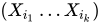
[edit]A function is -th order correlation immune if for any independent binary random variables , the random variable is independent from any random vector with .




Results in cryptography
[edit]When used in a stream cipher as a combining function for linear feedback shift registers, a Boolean function with low-order correlation-immunity is more susceptible to a correlation attack than a function with correlation immunity of high order.
Siegenthaler showed that the correlation immunity m of a Boolean function of algebraic degree d of n variables satisfies m + d ≤ n; for a given set of input variables, this means that a high algebraic degree will restrict the maximum possible correlation immunity. Furthermore, if the function is balanced then m + d ≤ n − 1.[1]
References
[edit]- ↑ T. Siegenthaler (September 1984). "Correlation-Immunity of Nonlinear Combining Functions for Cryptographic Applications". IEEE Transactions on Information Theory. 30 (5): 776–780. doi:10.1109/TIT.1984.1056949.
Further reading
[edit]- Cusick, Thomas W. & Stanica, Pantelimon (2009). "Cryptographic Boolean functions and applications". Academic Press. ISBN 9780123748904.

 | This cryptography-related article is a stub. You can help Wikipedia by adding missing information. |