


Copper coulometer

The copper coulometer is a coulometer consisting of two identical copper electrodes immersed in a slightly acidic pH-buffered solution of copper(II) sulfate (copper-copper(II) sulfate electrode).[1][2] Passing of current through the element leads to the anodic dissolution of the metal on anode and simultaneous deposition of copper ions on the cathode. These reactions have 100% efficiency over a wide range of current density.
Calculation
[edit]The amount of electric charge (quantity of electricity) passed through the cell can easily be determined by measuring the change in mass of either electrode and calculating:
- ,
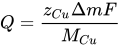
where:
- is the quantity of electricity (coulombs)
- is the mass transported (gm)
- is the charge of the copper ions, equal to +2
- is the Faraday constant (96485.3383 coulombs per mole)
- is the atomic weight of copper, equal to 63.546 grams per mole.


Although this apparatus is interesting from a theoretical and historical point of view, present-day electronic measurement of time and electric current provide in their multiplication the amount of passed coulombs much easier, with greater precision, and in a shorter period of time than is possible by weighing the electrodes.
See also
[edit]References
[edit]- ↑ Samuel Glasstone (16 April 2013). An Introduction to Electrochemistry. Read Books Limited. pp. 29–. ISBN 978-1-4465-4546-1.
- ↑ A.M. James; Cecil Whitfield Davies (18 June 1976). A Dictionary of Electrochemistry. Palgrave Macmillan UK. pp. 60–. ISBN 978-1-349-02820-7.
 | This physical chemistry-related article is a stub. You can help Wikipedia by adding missing information. |