


Hahn polynomials
In mathematics, Hahn polynomials are a family of orthogonal polynomials in the Askey scheme of hypergeometric orthogonal polynomials, introduced by Pafnuty Chebyshev[1] and rediscovered by Wolfgang Hahn.[2] The Hahn class is a name for special cases of Hahn polynomials, such as Meixner polynomials, Krawtchouk polynomials, and Charlier polynomials. Sometimes the Hahn class is taken to include limiting cases of these polynomials, in which case it also includes the classical orthogonal polynomials.
Hahn polynomials are defined in terms of generalized hypergeometric functions by[3]

for . If , these polynomials are identical to the discrete Chebyshev polynomials up to a scale factor.


Hahn polynomials have dual, continuous and continuous dual versions. These polynomials all have q-analogs. Hahn polynomials are a limiting case of Racah polynomials.[4]
Properties
[edit]Orthogonality
[edit]Hahn polynomials satisfy the orthogonality relations[citation needed]

where is the Kronecker delta and the weight functions are


and

Dual version
[edit]Hahn polynomials have a dual version, the dual Hahn polynomials, which are also a family of orthogonal polynomials in the Askey scheme of hypergeometric orthogonal polynomials. They are defined on a non-uniform lattice by[citation needed]


for , and the parameters are restricted to



Here is the rising factorial, and is a generalized hypergeometric function.


Roelof Koekoek, Peter A. Lesky, and René F. Swarttouw (2010, 14) give a detailed list of their properties.
Orthogonality
[edit]The dual Hahn polynomials satisfy the orthogonality condition

for , where ,



and

Numerical instability
[edit]As increases, the values that the discrete polynomials attain increase. As a result, obtaining numerical stability in calculating the polynomials requires the use of renormalized dual Hahn polynomials, defined as


for . Here the orthogonality condition becomes
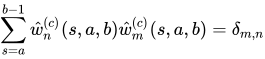
for

Continuous version
[edit]Hahn polynomials have a continuous version, the continuous Hahn polynomials, which are also a family of orthogonal polynomials in the Askey scheme of hypergeometric orthogonal polynomials. They are defined in terms of generalized hypergeometric functions by

Roelof Koekoek, Peter A. Lesky, and René F. Swarttouw (2010, 14) give a detailed list of their properties.
Orthogonality
[edit]The continuous Hahn polynomials are orthogonal with respect to the weight function

In particular, they satisfy the orthogonality relation[5][6][7]

for , , , , , .


Recurrence and difference relations
[edit]The sequence of continuous Hahn polynomials satisfies the recurrence relation[5]

where
![{\displaystyle {\begin{aligned}&{\tilde {p}}_{n}(x)={\tilde {p}}_{n}(x;a,b,c,d)={\frac {n!}{i^{n}(a+c)_{n}(a+d)_{n}}}p_{n}(x;a,b,c,d),\\[6pt]&A_{n}={\frac {-(n+a+b+c+d-1)(n+a+c)(n+a+d)}{(2n+a+b+c+d-1)(2n+a+b+c+d)}},\end{aligned}}}](https://wikimedia.org/api/rest_v1/media/math/render/svg/238264b0eb5b9e49236d9136b0bd0d1645cfbdf8)
and

Rodrigues formula
[edit]The continuous Hahn polynomials are given by the Rodrigues-type formula[8]
![{\displaystyle {\begin{aligned}&\Gamma (a+ix)\,\Gamma (b+ix)\,\Gamma (c-ix)\,\Gamma (d-ix)\,p_{n}(x;a,b,c,d)\\[5pt]&\quad ={\frac {(-1)^{n}}{n!}}{\frac {d^{n}}{dx^{n}}}\left(\Gamma \left(a+{\frac {n}{2}}+ix\right)\,\Gamma \left(b+{\frac {n}{2}}+ix\right)\,\Gamma \left(c+{\frac {n}{2}}-ix\right)\,\Gamma \left(d+{\frac {n}{2}}-ix\right)\right).\end{aligned}}}](https://wikimedia.org/api/rest_v1/media/math/render/svg/168da1f9940212c6cd42d458810708272c51a2c8)
Generating functions
[edit]The continuous Hahn polynomials have the following generating function:[8]
![{\displaystyle {\begin{aligned}&\sum _{n=0}^{\infty }{\frac {\Gamma (n+a+b+c+d)\,\Gamma (a+c+1)\,\Gamma (a+d+1)}{\Gamma (a+b+c+d)\,\Gamma (n+a+c+1)\,\Gamma (n+a+d+1)}}(-it)^{n}p_{n}(x;a,b,c,d)\\[4pt]&\qquad =(1-t)^{1-a-b-c-d}{}_{3}F_{2}\left({\begin{array}{c}{\frac {1}{2}}(a+b+c+d-1),{\frac {1}{2}}(a+b+c+d),a+ix\\a+c,a+d\end{array}};-{\frac {4t}{(1-t)^{2}}}\right).\end{aligned}}}](https://wikimedia.org/api/rest_v1/media/math/render/svg/eb9988d34cc75747b844ec782d861ae8b5f5a34b)
A second, distinct generating function is given by

Relation of continuous Hahn polynomials to other polynomials
[edit]- The Wilson polynomials are a generalization of the continuous Hahn polynomials.
- The Bateman polynomials Fn(x) are related to the special case a=b=c=d=1/2 of the continuous Hahn polynomials by

- The Jacobi polynomials Pn(α,β)(x) can be obtained as a limiting case of the continuous Hahn polynomials:[9]

Continuous dual Hahn polynomials
[edit]In mathematics, the continuous dual Hahn polynomials are a family of orthogonal polynomials in the Askey scheme of hypergeometric orthogonal polynomials. They are defined in terms of generalized hypergeometric functions by



Roelof Koekoek, Peter A. Lesky, and René F. Swarttouw (2010, 14) give a detailed list of their properties.
Closely related polynomials include the dual Hahn polynomials Rn(x;γ,δ,N), the continuous Hahn polynomials pn(x,a,b, a, b), and the Hahn polynomials. These polynomials all have q-analogs with an extra parameter q, such as the q-Hahn polynomials Qn(x;α,β, N;q), and so on.
Relation of continuous dual Hahn polynomials to other polynomials
[edit]- Wilson polynomials are a generalization of continuous dual Hahn polynomials
q-Hahn polynomials
[edit]In mathematics, the q-Hahn polynomials are a family of basic hypergeometric orthogonal polynomials in the basic Askey scheme. Roelof Koekoek, Peter A. Lesky, and René F. Swarttouw (2010, 14) give a detailed list of their properties.
Definition
[edit]The polynomials are given in terms of basic hypergeometric functions by
![{\displaystyle Q_{n}(q^{-x};a,b,N;q)={}_{3}\phi _{2}\left[{\begin{matrix}q^{-n},abq^{n+1},q^{-x}\\aq,q^{-N}\end{matrix}};q,q\right].}](https://wikimedia.org/api/rest_v1/media/math/render/svg/3245c47531fc3a72ccffe784d833e7a9eaa05327)
Dual q-Hahn polynomials
[edit]In mathematics, the dual q-Hahn polynomials are a family of basic hypergeometric orthogonal polynomials in the basic Askey scheme. Roelof Koekoek, Peter A. Lesky, and René F. Swarttouw (2010, 14) give a detailed list of their properties.
Definition
[edit]The polynomials are given in terms of basic hypergeometric functions.
![{\displaystyle R_{n}(q^{-x}+\gamma \delta q^{x+1},\gamma ,\delta ,N|q)={}_{3}\phi _{2}\left[{\begin{matrix}q^{-n},q^{-x},\gamma \delta q^{x+1}\\\gamma q,q^{-N}\end{matrix}};q,q\right],\quad n=0,1,2,...,N}](https://wikimedia.org/api/rest_v1/media/math/render/svg/f3f987966bca7e6403b481ff8b740cdb93afd415)
Continuous q-Hahn polynomials
[edit]In mathematics, the continuous q-Hahn polynomials are a family of basic hypergeometric orthogonal polynomials in the basic Askey scheme. Roelof Koekoek, Peter A. Lesky, and René F. Swarttouw (2010, 14) give a detailed list of their properties.
Definition
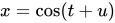
[edit]The polynomials are given in terms of basic hypergeometric functions and the q-Pochhammer symbol by [10]

Gallery
[edit] |
 |
 |
 |
 |
 |
Relation of q-Hahn polynomials to other polynomials
[edit]q-Hahn polynomials→ Quantum q-Krawtchouk polynomials:

q-Hahn polynomials→ Hahn polynomials
make the substitution, into definition of q-Hahn polynomials, and find the limit q→1, we obtain


- ,which is exactly Hahn polynomials.

Continuous dual q-Hahn polynomials
[edit]In mathematics, the continuous dual q-Hahn polynomials are a family of basic hypergeometric orthogonal polynomials in the basic Askey scheme. Roelof Koekoek, Peter A. Lesky, and René F. Swarttouw (2010, 14) give a detailed list of their properties.
Definition
[edit]The polynomials are given in terms of basic hypergeometric functions and the q-Pochhammer symbol by [11]

In which

Gallery
[edit] |
 |
 |
 |
 |
 |
Relation of Hahn polynomials to other polynomials
[edit]- Racah polynomials are a generalization of Hahn polynomials
Notes
[edit]- ↑ Chebyshev (1907).
- ↑ Hahn (1949).
- ↑ Koekoek, Lesky & Swarttouw (2010), p. 204.
- ↑ Koekoek, Lesky & Swarttouw (2010), p. 207.
- 1 2 Koekoek, Lesky & Swarttouw (2010), p. 200.
- ↑ Askey, R. (1985). "Continuous Hahn polynomials". Journal of Physics A: Mathematical and General. 18 (16): 1017–1019. doi:10.1088/0305-4470/18/16/004.
- ↑ Andrews, Askey & Roy (1999), p. 333.
- 1 2 Koekoek, Lesky & Swarttouw (2010), p. 202.
- ↑ Koekoek, Lesky, & Swarttouw (2010), p. 203.
- ↑ Roelof p433, Springer 2010
- ↑ Mesuma Atakishiyeva, Natig Atakishieyev, A NON STANDARD GENERATING FUNCTION FOR CONTINUOUS DUAL Q-HAHN POLYNOMIALS, REVISTA DE MATEMATICA 2011 18(1):111-120
References
[edit]- Andrews, George E.; Askey, Richard; Roy, Ranjan (1999). Special Functions. Encyclopedia of Mathematics and its Applications. Vol. 71. Cambridge University Press. ISBN 978-0-521-62321-6.
- Chebyshev, P. (1907). "Sur l'interpolation des valeurs équidistantes". In Markoff, A.; Sonin, N. (eds.). Œuvres de P. L. Tchebychef (in French). Vol. 2. Saint Petersburg: Russian Academy of Sciences. pp. 219–242.
- Costas-Santos, R. S.; Sánchez-Lara, J. F. (2011). "Orthogonality of q-polynomials for non-standard parameters". Journal of Approximation Theory. 163 (9): 1246–1268. doi:10.1016/j.jat.2011.04.005.
- Gasper, George; Rahman, Mizan (2004) [1990]. Basic Hypergeometric Series. Encyclopedia of Mathematics and its Applications. Vol. 96 (2nd ed.). Cambridge University Press. ISBN 978-0-521-83357-8. MR 2128719.
- Hahn, Wolfgang (1949). "Über Orthogonalpolynome, die q-Differenzengleichungen genügen". Mathematische Nachrichten (in German). 2 (1–2): 4–34. doi:10.1002/mana.19490020103. MR 0030647.
- Koekoek, Roelof; Lesky, Peter A.; Swarttouw, René F. (2010). Hypergeometric Orthogonal Polynomials and Their q-Analogues. Springer Monographs in Mathematics. Berlin, Heidelberg: Springer. ISBN 978-3-642-05013-8. MR 2656096.
- Koornwinder, Tom H.; Wong, Roderick S. C.; Koekoek, Roelof; Swarttouw, René F. (2010), "Hahn class: definitions", in Olver, Frank W. J.; Lozier, Daniel M.; Boisvert, Ronald F.; Clark, Charles W. (eds.), NIST Handbook of Mathematical Functions, Cambridge University Press, ISBN 978-0-521-19225-5, MR 2723248.
- Koornwinder, T. H.; Wong, R.; Koekoek, R.; Swarttouw, R. F. (2010), "Orthogonal polynomials", in Olver, Frank W. J.; Lozier, Daniel M.; Boisvert, Ronald F.; Clark, Charles W. (eds.), NIST Handbook of Mathematical Functions, Cambridge University Press, ISBN 978-0-521-19225-5, MR 2723248.
- Sadjang, Patrick Njionou. Moments of Classical Orthogonal Polynomials (Ph.D. thesis). University of Kassel.
- Zhu, Hongqing; Shu, Huazhong; Zhou, Jian; Luo, Limin; Coatrieux, J. L. (2007). "Image analysis by discrete orthogonal dual Hahn moments" (PDF). Pattern Recognition Letters. 28 (13): 1688–1704. doi:10.1016/j.patrec.2007.04.013.