


Connection (affine bundle)
 | This article has been nominated for merging into Affine bundle. You are welcome to participate in the merging discussion, which will decide whether to merge it into Affine bundle. This discussion may also result in the article being deleted, redirected, or draftified. |
 | This article has multiple issues. Please help improve it or discuss these issues on the talk page. (Learn how and when to remove these messages)
|


In differential geometry, a connection on an affine bundle is a specialisation to affine bundles of the more general notion of a connection on a principal bundle. Let Y → X be an affine bundle modelled over a vector bundle Y → X. A connection Γ on Y → X is called an affine connection if, as a section Γ : Y → J1Y of the jet bundle J1Y → Y of Y, it is an affine bundle morphism over X.
The term "affine connection" as used in this article should not be confused with its more common usage, namely a connection on the tangent bundle TX of a smooth manifold X, though as discussed below, the latter can be considered as a special example of the former.
With respect to affine bundle coordinates (xλ, yi) on Y, an affine connection Γ on Y → X is given by the tangent-valued connection form
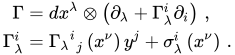
An affine bundle is a fiber bundle with a general affine structure group GA(m, ℝ) of affine transformations of its typical fiber V of dimension m. Therefore, an affine connection is associated to a principal connection. It always exists.
For any affine connection Γ : Y → J1Y, the corresponding linear derivative Γ : Y → J1Y of an affine morphism Γ defines a unique linear connection on a vector bundle Y → X. With respect to linear bundle coordinates (xλ, yi) on Y, this connection reads

Since every vector bundle is an affine bundle, any linear connection on a vector bundle also is an affine connection.
If Y → X is a vector bundle, both an affine connection Γ and an associated linear connection Γ are connections on the same vector bundle Y → X, and their difference is a basic soldering form on

Thus, every affine connection on a vector bundle Y → X is a sum of a linear connection and a basic soldering form on Y → X.
Due to the canonical vertical splitting VY = Y × Y, this soldering form is brought into a vector-valued form

where ei is a fiber basis for Y.
Given an affine connection Γ on a vector bundle Y → X, let R and R be the curvatures of a connection Γ and the associated linear connection Γ, respectively. It is readily observed that R = R + T, where

is the torsion of Γ with respect to the basic soldering form σ.
In particular, consider the tangent bundle TX of a manifold X coordinated by (xμ, ẋμ). There is the canonical soldering form
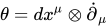
on TX which coincides with the tautological one-form
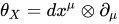
on X due to the canonical vertical splitting VTX = TX × TX. Given an arbitrary linear connection Γ on TX, the corresponding affine connection
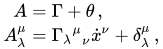
on TX is the Cartan connection. The torsion of the Cartan connection A with respect to the soldering form θ coincides with the torsion of a linear connection Γ, and its curvature is a sum R + T of the curvature and the torsion of Γ.
See also
[edit]References
[edit]- Sardanashvily, G. (2013). Advanced Differential Geometry for Theoreticians. Fiber bundles, jet manifolds and Lagrangian theory. Lambert Academic Publishing. arXiv:0908.1886. Bibcode:2009arXiv0908.1886S. ISBN 978-3-659-37815-7.
 | This differential geometry–related article is a stub. You can help Wikipedia by adding missing information. |