


Community matrix
In mathematical biology, the community matrix is the linearization of a generalized Lotka–Volterra equation at an equilibrium point.[1] The eigenvalues of the community matrix determine the stability of the equilibrium point.
For example, the Lotka–Volterra predator–prey model is
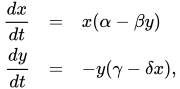
where x(t) denotes the number of prey, y(t) the number of predators, and α, β, γ and δ are constants. By the Hartman–Grobman theorem the non-linear system is topologically equivalent to a linearization of the system about an equilibrium point (x*, y*), which has the form
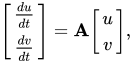
where u = x − x* and v = y − y*. In mathematical biology, the Jacobian matrix evaluated at the equilibrium point (x*, y*) is called the community matrix.[2] By the stable manifold theorem, if one or both eigenvalues of have positive real part then the equilibrium is unstable, but if all eigenvalues have negative real part then it is stable.

See also
[edit]References
[edit]- ↑ Berlow, E. L.; Neutel, A.-M.; Cohen, J. E.; De Ruiter, P. C.; Ebenman, B.; Emmerson, M.; Fox, J. W.; Jansen, V. A. A.; Jones, J. I.; Kokkoris, G. D.; Logofet, D. O.; McKane, A. J.; Montoya, J. M; Petchey, O. (2004). "Interaction Strengths in Food Webs: Issues and Opportunities". Journal of Animal Ecology. 73 (5): 585–598. Bibcode:2004JAnEc..73..585B. doi:10.1111/j.0021-8790.2004.00833.x. JSTOR 3505669.
- ↑ Kot, Mark (2001). Elements of Mathematical Ecology. Cambridge University Press. p. 144. ISBN 0-521-00150-1.
- Murray, James D. (2002), Mathematical Biology I. An Introduction, Interdisciplinary Applied Mathematics, vol. 17 (3rd ed.), Berlin, New York: Springer-Verlag, ISBN 978-0-387-95223-9.
 | This applied mathematics–related article is a stub. You can help Wikipedia by adding missing information. |