


Coding gain
 | This article has multiple issues. Please help improve it or discuss these issues on the talk page. (Learn how and when to remove these messages)
|


In coding theory, telecommunications engineering and other related engineering problems, coding gain is the measure in the difference between the signal-to-noise ratio (SNR) levels between the uncoded system and coded system required to reach the same bit error rate (BER) levels when used with the error correcting code (ECC).
Example
[edit]If the uncoded BPSK system in AWGN environment has a bit error rate (BER) of 10−2 at the SNR level 4 dB, and the corresponding coded (e.g., BCH) system has the same BER at an SNR of 2.5 dB, then we say the coding gain = 4 dB − 2.5 dB = 1.5 dB, due to the code used (in this case BCH).
Power-limited regime
[edit]In the power-limited regime (where the nominal spectral efficiency [b/2D or b/s/Hz], i.e. the domain of binary signaling), the effective coding gain of a signal set at a given target error probability per bit is defined as the difference in dB between the required to achieve the target with and the required to achieve the target with 2-PAM or (2×2)-QAM (i.e. no coding). The nominal coding gain is defined as


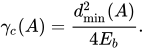
This definition is normalized so that for 2-PAM or (2×2)-QAM. If the average number of nearest neighbors per transmitted bit is equal to one, the effective coding gain is approximately equal to the nominal coding gain . However, if , the effective coding gain is less than the nominal coding gain by an amount which depends on the steepness of the vs. curve at the target . This curve can be plotted using the union bound estimate (UBE)


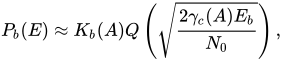
where Q is the Gaussian probability-of-error function.
For the special case of a binary linear block code with parameters , the nominal spectral efficiency is and the nominal coding gain is kd/n.


Example
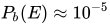
[edit]The table below lists the nominal spectral efficiency, nominal coding gain and effective coding gain at for Reed–Muller codes of length :

| Code | (dB) | (dB) | |||
|---|---|---|---|---|---|
| [8,7,2] | 1.75 | 7/4 | 2.43 | 4 | 2.0 |
| [8,4,4] | 1.0 | 2 | 3.01 | 4 | 2.6 |
| [16,15,2] | 1.88 | 15/8 | 2.73 | 8 | 2.1 |
| [16,11,4] | 1.38 | 11/4 | 4.39 | 13 | 3.7 |
| [16,5,8] | 0.63 | 5/2 | 3.98 | 6 | 3.5 |
| [32,31,2] | 1.94 | 31/16 | 2.87 | 16 | 2.1 |
| [32,26,4] | 1.63 | 13/4 | 5.12 | 48 | 4.0 |
| [32,16,8] | 1.00 | 4 | 6.02 | 39 | 4.9 |
| [32,6,16] | 0.37 | 3 | 4.77 | 10 | 4.2 |
| [64,63,2] | 1.97 | 63/32 | 2.94 | 32 | 1.9 |
| [64,57,4] | 1.78 | 57/16 | 5.52 | 183 | 4.0 |
| [64,42,8] | 1.31 | 21/4 | 7.20 | 266 | 5.6 |
| [64,22,16] | 0.69 | 11/2 | 7.40 | 118 | 6.0 |
| [64,7,32] | 0.22 | 7/2 | 5.44 | 18 | 4.6 |


Bandwidth-limited regime
[edit]In the bandwidth-limited regime (, i.e. the domain of non-binary signaling), the effective coding gain of a signal set at a given target error rate is defined as the difference in dB between the required to achieve the target with and the required to achieve the target with M-PAM or (M×M)-QAM (i.e. no coding). The nominal coding gain is defined as


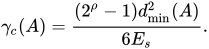
This definition is normalized so that for M-PAM or (M×M)-QAM. The UBE becomes

where is the average number of nearest neighbors per two dimensions.

See also
[edit]References
[edit]MIT OpenCourseWare, 6.451 Principles of Digital Communication II, Lecture Notes sections 5.3, 5.5, 6.3, 6.4