


Chebyshev equation
Chebyshev's equation is the second order linear differential equation

where p is a real (or complex) constant. The equation is named after Russian mathematician Pafnuty Chebyshev. The solutions can be obtained by power series:

where the coefficients obey the recurrence relation
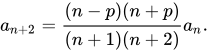
The series converges for (note, x may be complex), as may be seen by applying the ratio test to the recurrence. The recurrence may be started with arbitrary values of a0 and a1, leading to the two-dimensional space of solutions that arises from second-order differential equations. The standard choices are:

- a0 = 1 ; a1 = 0, leading to the solution

and
- a0 = 0 ; a1 = 1, leading to the solution

The general solution is any linear combination of these two.
When p is a non-negative integer, one or the other of the two functions has its series terminate after a finite number of terms: F terminates if p is even, and G terminates if p is odd. In this case, that function is a polynomial of degree p and it is proportional to the Chebyshev polynomial of the first kind
- if p is even
- if p is odd


This article incorporates material from Chebyshev equation on PlanetMath, which is licensed under the Creative Commons Attribution/Share-Alike License.