


// Workers AI · dad joke modeWhat did the Chandrasekhar potential energy tensor say? "I've got a lot of stress.
In astrophysics, Chandrasekhar potential energy tensor provides the gravitational potential of a body due to its own gravity created by the distribution of matter across the body, named after the Indian American astrophysicist Subrahmanyan Chandrasekhar.[1][2][3] The Chandrasekhar tensor is a generalization of potential energy in other words, the trace of the Chandrasekhar tensor provides the potential energy of the body.
Definition
[edit]The Chandrasekhar potential energy tensor is defined as

where

where
- is the Gravitational constant
- is the self-gravitating potential from Newton's law of gravity
- is the generalized version of
- is the matter density distribution
- is the volume of the body


It is evident that is a symmetric tensor from its definition. The trace of the Chandrasekhar tensor is nothing but the potential energy .



Hence Chandrasekhar tensor can be viewed as the generalization of potential energy.[4]
Chandrasekhar's Proof
[edit]Consider a matter of volume with density . Thus
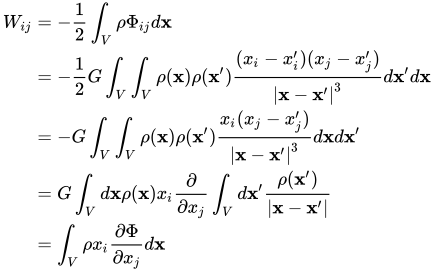
Chandrasekhar tensor in terms of scalar potential
[edit]The scalar potential is defined as

then Chandrasekhar[5] proves that
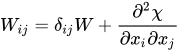
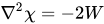
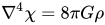
Setting we get , taking Laplacian again, we get .

See also
[edit]References
[edit]- ↑ Chandrasekhar, S; Lebovitz NR (1962). "The Potentials and the Superpotentials of Homogeneous Ellipsoids" (PDF). Ap. J. 136: 1037–1047. Bibcode:1962ApJ...136.1037C. doi:10.1086/147456. Retrieved March 24, 2012.
- ↑ Chandrasekhar, S; Fermi E (1953). "Problems of Gravitational Stability in the Presence of a Magnetic Field" (PDF). Ap. J. 118: 116. Bibcode:1953ApJ...118..116C. doi:10.1086/145732. Retrieved March 24, 2012.
- ↑ Chandrasekhar, Subrahmanyan. Ellipsoidal figures of equilibrium. Vol. 9. New Haven: Yale University Press, 1969.
- ↑ Binney, James; Tremaine, Scott (30 October 2011). Galactic Dynamics (Second ed.). Princeton University Press. pp. 59–60. ISBN 978-1400828722.
- ↑ Chandrasekhar, Subrahmanyan. Ellipsoidal figures of equilibrium. Vol. 9. New Haven: Yale University Press, 1969.