


Cauchy process
In probability theory, a Cauchy process is a type of stochastic process. There are symmetric and asymmetric forms of the Cauchy process.[1] The unspecified term "Cauchy process" is often used to refer to the symmetric Cauchy process.[2]
The Cauchy process has a number of properties:
- It is a Lévy process[3][4][5]
- It is a stable process[1][2]
- It is a pure jump process[6]
- Its moments are infinite.
Symmetric Cauchy process
[edit]
The symmetric Cauchy process can be described by a Brownian motion or Wiener process subject to a Lévy subordinator.[7] The Lévy subordinator is a process associated with a Lévy distribution having location parameter of and a scale parameter of .[7] The Lévy distribution is a special case of the inverse-gamma distribution. So, using to represent the Cauchy process and to represent the Lévy subordinator, the symmetric Cauchy process can be described as:



The Lévy distribution is the probability of the first hitting time for a Brownian motion, and thus the Cauchy process is essentially the result of two independent Brownian motion processes.[7]
The Lévy–Khintchine representation for the symmetric Cauchy process is a triplet with zero drift and zero diffusion, giving a Lévy–Khintchine triplet of , where .[8]


The marginal characteristic function of the symmetric Cauchy process has the form:[1][8]
![{\displaystyle \operatorname {E} {\Big [}e^{i\theta X_{t}}{\Big ]}=e^{-t|\theta |}.}](https://wikimedia.org/api/rest_v1/media/math/render/svg/d8cbd54f35159559645600415ec5852b783b2353)
The marginal probability distribution of the symmetric Cauchy process is the Cauchy distribution whose density is[8][9]
![{\displaystyle f(x;t)={1 \over \pi }\left[{t \over x^{2}+t^{2}}\right].}](https://wikimedia.org/api/rest_v1/media/math/render/svg/33f3f4481cd6c44c4348a891fb2252bdbfccf439)
Asymmetric Cauchy process
[edit]The asymmetric Cauchy process is defined in terms of a parameter . Here is the skewness parameter, and its absolute value must be less than or equal to 1.[1] In the case where the process is considered a completely asymmetric Cauchy process.[1]


The Lévy–Khintchine triplet has the form , where , where , and .[1]
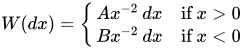


Given this, is a function of and .


The characteristic function of the asymmetric Cauchy distribution has the form:[1]
![{\displaystyle \operatorname {E} {\Big [}e^{i\theta X_{t}}{\Big ]}=e^{-t(|\theta |+i\beta \theta \ln |\theta |/(2\pi ))}.}](https://wikimedia.org/api/rest_v1/media/math/render/svg/3ba01d6f0ede388523c63e8e88b6866ce2525c4c)
The marginal probability distribution of the asymmetric Cauchy process is a stable distribution with index of stability (i.e., α parameter) equal to 1.
References
[edit]- 1 2 3 4 5 6 7 Kovalenko, I.N.; et al. (1996). Models of Random Processes: A Handbook for Mathematicians and Engineers. CRC Press. pp. 210–211. ISBN 9780849328701.
- 1 2 Engelbert, H.J., Kurenok, V.P. & Zalinescu, A. (2006). "On Existence and Uniqueness of Reflected Solutions of Stochastic Equations Driven by Symmetric Stable Processes". In Kabanov, Y.; Liptser, R.; Stoyanov, J. (eds.). From Stochastic Calculus to Mathematical Finance: The Shiryaev Festschrift. Springer. p. 228. ISBN 9783540307884.
{{cite book}}: CS1 maint: multiple names: authors list (link) - ↑ Winkel, M. "Introduction to Levy processes" (PDF). pp. 15–16. Retrieved 2013-02-07.
- ↑ Jacob, N. (2005). Pseudo Differential Operators & Markov Processes: Markov Processes And Applications, Volume 3. Imperial College Press. p. 135. ISBN 9781860945687.
- ↑ Bertoin, J. (2001). "Some elements on Lévy processes". In Shanbhag, D.N. (ed.). Stochastic Processes: Theory and Methods. Gulf Professional Publishing. p. 122. ISBN 9780444500144.
- ↑ Kroese, D.P.; Taimre, T.; Botev, Z.I. (2011). Handbook of Monte Carlo Methods. John Wiley & Sons. p. 214. ISBN 9781118014950.
- 1 2 3 Applebaum, D. "Lectures on Lévy processes and Stochastic calculus, Braunschweig; Lecture 2: Lévy processes" (PDF). University of Sheffield. pp. 37–53. Archived from the original (PDF) on 2015-06-05.
- 1 2 3 Cinlar, E. (2011). Probability and Stochastics. Springer. p. 332. ISBN 9780387878591.
- ↑ Itô, K. (2006). Essentials of Stochastic Processes. American Mathematical Society. p. 54. ISBN 9780821838983.