


Cass criterion
The Cass criterion, also known as the Malinvaud–Cass criterion, is a central result in theory of overlapping generations models in economics. It is named after David Cass.[1][2]
A major feature which sets overlapping generations models in economics apart from the standard model with a finite number of infinitely lived individuals is that the First Welfare Theorem might not hold—that is, competitive equilibria may be not be Pareto optimal.
If represents the vector of Arrow–Debreu commodity prices prevailing in period and if


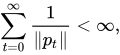
then a competitive equilibrium allocation is inefficient.[3]
References
[edit]- ↑ Cass, David (1972), "On capital overaccumulation in the aggregative neoclassical model of economic growth: a complete characterization", Journal of Economic Theory, 4 (2): 200–223, doi:10.1016/0022-0531(72)90149-4
- ↑ Balasko, Yves; Shell, Karl (1980), "The overlapping generations model, I: the case of pure exchange without money", Journal of Economic Theory, 23 (3): 281–306, doi:10.1016/0022-0531(80)90013-7
- ↑ Farmer, Roger E. A. (1999). The Macroeconomics of Self-fulfilling Prophecies. MIT Press. p. 132. ISBN 9780262062039.
 | This economics-related article is a stub. You can help Wikipedia by adding missing information. |