


// Workers AI · dad joke modeWhy did Carl Oscar Borg's art go to therapy? It was struggling to draw support.

Carl Oscar (or Oskar) Borg (March 3, 1879 – May 8, 1947) was a Swedish-born painter who settled in the United States and became known for views of California and the Southwest.[1] He worked as a Southwest and California landscape painter, a poster artist for the Atchison, Topeka and Santa Fe Railway, and, in the mid-1920s, as a Hollywood art director.[2]
Biography
[edit source]Carl Oscar Borg was born into a poor family in Grinstad parish, Dalsland province, Sweden. Oscar Borg moved to London at age 15 to assist portrait and marine artist George Johansen. In 1901, he sailed for the United States.[1] Borg taught art at the California Art Institute in Los Angeles and at the Santa Barbara School of the Arts. He became a protégé of American philanthropist and art patron Phoebe Hearst. She gave him the opportunity to return to Europe to study art.
Borg was influenced by the nature of the southwestern United States, especially the states of Arizona and New Mexico. He worked in various mediums including oil, watercolor, etchings, and woodblock. He was commissioned to paint posters for the railway company, Atchison, Topeka and Santa Fe Railway. His posters were put up on the company's sales offices and attracted attention. He was known for his dramatic paintings of the Grand Canyon.[3]
Borg was a founding member of the Painter's Club of Los Angeles and the California Art Club.[2] He was one of the first art directors for a major movie studio in Hollywood, working on silent film productions in the years 1925–1928;[2] he served as supervising art director on Douglas Fairbanks's Technicolor swashbuckler The Black Pirate (1926), overseeing construction of the film's pirate-ship sets.[4] Examples of his art are on display at Brigham Young University, Harvard University, Smithsonian American Art Museum and the Fine Arts Museums of San Francisco.[5] A substantial collection of his paintings and prints, as well as large parts of his personal collection, were given to the Världskulturmuseet in Gothenburg and Etnografiska museet in Stockholm, both branches of the Statens museer för världskultur (National Museums of World Culture) in Sweden, as gifts during his lifetime and by his widow.[citation needed]
His work was also part of the painting event in the art competition at the 1936 Summer Olympics.[6]
Personal life
[edit source]Borg was married to Lily Borg Elmberg. He was a member of the National Academy of Design, the National Academy of Art, Société Nationale des Beaux-Arts and the Salmagundi Club.[2]
Selected works
[edit source] Walpi Women
 Watching the Race
 Open Door at the Governor's Palace
 Wagon Train
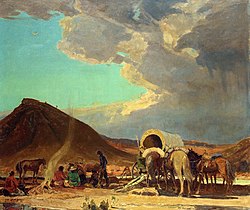 Indian encampment
 The Badlands, Arizona
 Indian at Work
 Wild Horses, Nevada


References
[edit source]- 1 2 Sublette, Mark. "Carl Oscar Borg (1879-1947)". Medicine Man Gallery. Archived from the original on 25 August 2017. Retrieved 25 August 2017.
- 1 2 3 4 "Carl Oscar Borg scrapbooks, 1903-1955: Biographical Note". Archives of American Art. Smithsonian Institution. Retrieved 31 July 2026.
- ↑ Miller, Marlene R. "Carl Oscar Borg, Artist of the American West". Traditional Fine Arts Organization. Archived from the original on January 17, 2010.
- ↑ "The Black Pirate". San Francisco Silent Film Festival. Retrieved 31 July 2026.
- ↑ Malyon, John. "Carl Oscar Borg". Artcyclopedia. Specifica, Inc.
- ↑ "Carl Oscar Borg". Olympedia. Retrieved 14 August 2020.
Further reading
[edit source]- Widén, Albin (1953). Carl Oscar Borg; Ett Konstnärsöde. Nordisk Rotogravyr.
- Laird, Helen (1986). Carl Oscar Borg and the Magic Region: Artist of the American West. Peregrine Smith Books.
- Schulz, Marlene R. (1990). Carl Oscar Borg: California Images. Santa Barbara Historical Society.
- Cuba, Stanley L. (1986). Carl Oscar Borg, Chronicler of the Southwest. Western Art Digest.
External links
[edit source]- Carl Oscar Borg scrapbooks at the Smithsonian Archives of American Art
- Carl Oscar Borg Artist and Gallery web site
- Art Signature Dictionary, genuine signature by the artist Carl Oscar Borg Here are several examples of Carl Oscar Borg's signature.
| International | |
|---|---|
| National | |
| Artists | |
| Other | |
