


// Workers AI · dad joke modeWhat did the bubble point say? I'm at a boiling point.

In thermodynamics, the bubble point is the temperature (at a given pressure) where the first bubble of vapor is formed when heating a liquid consisting of two or more components.[1][2] Given that vapor will probably have a different composition than the liquid, the bubble point (along with the dew point) at different compositions are useful data when designing distillation systems.[3]
For a single component the bubble point and the dew point are the same and are referred to as the boiling point.
Calculating the bubble point
[edit]At the bubble point, the following relationship holds:
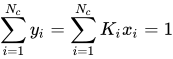
where
- .

K is the distribution coefficient or K factor, defined as the ratio of mole fraction in the vapor phase to the mole fraction in the liquid phase at equilibrium.
When Raoult's law and Dalton's law hold for the mixture, the K factor is defined as the ratio of the vapor pressure to the total pressure of the system:[1]


Given either of or and either the temperature or pressure of a two-component system, calculations can be performed to determine the unknown information.[4]


See also
[edit]References
[edit]- 1 2 McCabe, Warren L.; Smith, Julian C.; Harriot, Peter (2005), Unit Operations of Chemical Engineering (seventh ed.), New York: McGraw-Hill, pp. 737–738, ISBN 0-07-284823-5
- ↑ Smith, J. M.; Van Ness, H. C.; Abbott, M. M. (2005), Introduction to Chemical Engineering Thermodynamics (seventh ed.), New York: McGraw-Hill, p. 342, ISBN 0-07-310445-0
- ↑ Perry, R.H.; Green, D.W., eds. (1997). Perry's Chemical Engineers' Handbook (7th ed.). McGraw-hill. ISBN 0-07-049841-5.
- ↑ Smith, J. M.; Van Ness, H. C.; Abbott, M. M. (2005), Introduction to Chemical Engineering Thermodynamics (seventh ed.), New York: McGraw-Hill, p. 351, ISBN 0-07-310445-0