


Boyle temperature

The Boyle temperature, named after Robert Boyle, is formally defined as the temperature for which the second virial coefficient, , becomes zero. It is at this temperature that the attractive forces and the repulsive forces acting on the gas particles balance out

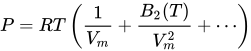
This is the virial equation of state and describes a real gas.
Since higher order virial coefficients are generally much smaller than the second coefficient, the gas tends to behave as an ideal gas over a wider range of pressures when the temperature reaches the Boyle temperature (or when or are minimized).


In any case, when the pressures are low, the second virial coefficient will be the only relevant one because the remaining concern terms of higher order on the pressure. Also at Boyle temperature the dip in a PV diagram tends to a straight line over a period of pressure. We then have
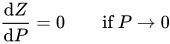
where is the compressibility factor.

Expanding the van der Waals equation in one finds that .[1][2]


See also
[edit]References
[edit]- ↑ Verma, K.S. Cengage Physical Chemistry Part 1. ISBN 978-81-315-3380-2 Section 5.14
- ↑ Smart learning (2015-10-22), Derivation of Boyle Temp from real Gas Equation Lecture Note-31 Class XI Chemistry, archived from the original on 2021-12-14, retrieved 2018-01-14