


// Workers AI · dad joke modeWhat did Bonnet's theorem wear? A head-turning bonnet.
In classical mechanics, Bonnet's theorem states that if n different force fields each produce the same geometric orbit (say, an ellipse of given dimensions) albeit with different speeds v1, v2,...,vn at a given point P, then the same orbit will be followed if the speed at point P equals

History
[edit]This theorem was first derived by Adrien-Marie Legendre in 1817,[1] but it is named after Pierre Ossian Bonnet.
Derivation
[edit]The shape of an orbit is determined only by the centripetal forces at each point of the orbit, which are the forces acting perpendicular to the orbit. By contrast, forces along the orbit change only the speed, but not the direction, of the velocity.
Let the instantaneous radius of curvature at a point P on the orbit be denoted as R. For the kth force field that produces that orbit, the force normal to the orbit Fk must provide the centripetal force

Adding all these forces together yields the equation
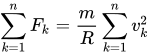
Hence, the combined force-field produces the same orbit if the speed at a point P is set equal to
References
[edit]- ↑ Legendre, A-M (1817). Exercises de Calcul Intégral. Vol. 2. Paris: Courcier. pp. 382–3.