


Block reflector
 | This article needs more citations. (May 2021) |
"A block reflector is an orthogonal, symmetric matrix that reverses a subspace whose dimension may be greater than one."[1]
It is built out of many elementary reflectors.
It is also referred to as a triangular factor, and is a triangular matrix and they are used in the Householder transformation.
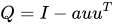
A reflector belonging to can be written in the form : where is the identity matrix for , is a scalar and belongs to .




LAPACK routines
[edit]Here are some of the LAPACK routines that apply to block reflectors
- "*larft" forms the triangular vector T of a block reflector H=I-VTVH.
- "*larzb" applies a block reflector or its transpose/conjugate transpose as returned by "*tzrzf" to a general matrix.
- "*larzt" forms the triangular vector T of a block reflector H=I-VTVH as returned by "*tzrzf".
- "*larfb" applies a block reflector or its transpose/conjugate transpose to a general rectangular matrix.
See also
[edit]References
[edit]- ↑ Schreiber, Rober; Parlett, Beresford (2006). "Block Reflectors: Theory and Computation". SIAM Journal on Numerical Analysis. 25: 189–205. doi:10.1137/0725014.
 | This article about matrices is a stub. You can help Wikipedia by adding missing information. |
 | This computer-programming-related article is a stub. You can help Wikipedia by adding missing information. |