From Wikipedia, the free encyclopedia
Consider a column-wise partitioned matrix:
[
A
B
]
,
A
∈
R
m
×
n
,
B
∈
R
m
×
p
,
m
≥
n
+
p
.
{\displaystyle {\begin{bmatrix}\mathbf {A} &\mathbf {B} \end{bmatrix}},\quad \mathbf {A} \in \mathbb {R} ^{m\times n},\quad \mathbf {B} \in \mathbb {R} ^{m\times p},\quad m\geq n+p.}
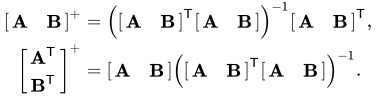
If the above matrix is full column rank, the Moore–Penrose inverse matrices of it and its transpose are
[
A
B
]
+
=
(
[
A
B
]
T
[
A
B
]
)
−
1
[
A
B
]
T
,
[
A
T
B
T
]
+
=
[
A
B
]
(
[
A
B
]
T
[
A
B
]
)
−
1
.
{\displaystyle {\begin{aligned}{\begin{bmatrix}\mathbf {A} &\mathbf {B} \end{bmatrix}}^{+}&=\left({\begin{bmatrix}\mathbf {A} &\mathbf {B} \end{bmatrix}}^{\textsf {T}}{\begin{bmatrix}\mathbf {A} &\mathbf {B} \end{bmatrix}}\right)^{-1}{\begin{bmatrix}\mathbf {A} &\mathbf {B} \end{bmatrix}}^{\textsf {T}},\\{\begin{bmatrix}\mathbf {A} ^{\textsf {T}}\\\mathbf {B} ^{\textsf {T}}\end{bmatrix}}^{+}&={\begin{bmatrix}\mathbf {A} &\mathbf {B} \end{bmatrix}}\left({\begin{bmatrix}\mathbf {A} &\mathbf {B} \end{bmatrix}}^{\textsf {T}}{\begin{bmatrix}\mathbf {A} &\mathbf {B} \end{bmatrix}}\right)^{-1}.\end{aligned}}}
This computation of the pseudoinverse requires (n + p )-square matrix inversion and does not take advantage of the block form.
To reduce computational costs to n - and p -square matrix inversions and to introduce parallelism, treating the blocks separately, one derives [ 1]
[
A
B
]
+
=
[
P
B
⊥
A
(
A
T
P
B
⊥
A
)
−
1
P
A
⊥
B
(
B
T
P
A
⊥
B
)
−
1
]
=
[
(
P
B
⊥
A
)
+
(
P
A
⊥
B
)
+
]
,
[
A
T
B
T
]
+
=
[
P
B
⊥
A
(
A
T
P
B
⊥
A
)
−
1
,
P
A
⊥
B
(
B
T
P
A
⊥
B
)
−
1
]
=
[
(
A
T
P
B
⊥
)
+
(
B
T
P
A
⊥
)
+
]
,
{\displaystyle {\begin{aligned}{\begin{bmatrix}\mathbf {A} &\mathbf {B} \end{bmatrix}}^{+}&={\begin{bmatrix}\mathbf {P} _{B}^{\perp }\mathbf {A} \left(\mathbf {A} ^{\textsf {T}}\mathbf {P} _{B}^{\perp }\mathbf {A} \right)^{-1}\\\mathbf {P} _{A}^{\perp }\mathbf {B} \left(\mathbf {B} ^{\textsf {T}}\mathbf {P} _{A}^{\perp }\mathbf {B} \right)^{-1}\end{bmatrix}}={\begin{bmatrix}\left(\mathbf {P} _{B}^{\perp }\mathbf {A} \right)^{+}\\\left(\mathbf {P} _{A}^{\perp }\mathbf {B} \right)^{+}\end{bmatrix}},\\{\begin{bmatrix}\mathbf {A} ^{\textsf {T}}\\\mathbf {B} ^{\textsf {T}}\end{bmatrix}}^{+}&={\begin{bmatrix}\mathbf {P} _{B}^{\perp }\mathbf {A} \left(\mathbf {A} ^{\textsf {T}}\mathbf {P} _{B}^{\perp }\mathbf {A} \right)^{-1},\quad \mathbf {P} _{A}^{\perp }\mathbf {B} \left(\mathbf {B} ^{\textsf {T}}\mathbf {P} _{A}^{\perp }\mathbf {B} \right)^{-1}\end{bmatrix}}={\begin{bmatrix}\left(\mathbf {A} ^{\textsf {T}}\mathbf {P} _{B}^{\perp }\right)^{+}&\left(\mathbf {B} ^{\textsf {T}}\mathbf {P} _{A}^{\perp }\right)^{+}\end{bmatrix}},\end{aligned}}}
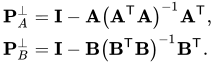
where orthogonal projection matrices are defined by
P
A
⊥
=
I
−
A
(
A
T
A
)
−
1
A
T
,
P
B
⊥
=
I
−
B
(
B
T
B
)
−
1
B
T
.
{\displaystyle {\begin{aligned}\mathbf {P} _{A}^{\perp }&=\mathbf {I} -\mathbf {A} \left(\mathbf {A} ^{\textsf {T}}\mathbf {A} \right)^{-1}\mathbf {A} ^{\textsf {T}},\\\mathbf {P} _{B}^{\perp }&=\mathbf {I} -\mathbf {B} \left(\mathbf {B} ^{\textsf {T}}\mathbf {B} \right)^{-1}\mathbf {B} ^{\textsf {T}}.\end{aligned}}}
The above formulas are not necessarily valid if
[
A
B
]
{\displaystyle {\begin{bmatrix}\mathbf {A} &\mathbf {B} \end{bmatrix}}}
A
≠
0
{\displaystyle \mathbf {A} \neq 0}
[
A
A
]
+
=
1
2
[
A
+
A
+
]
≠
[
(
P
A
⊥
A
)
+
(
P
A
⊥
A
)
+
]
=
0
{\displaystyle {\begin{bmatrix}\mathbf {A} &\mathbf {A} \end{bmatrix}}^{+}={\frac {1}{2}}{\begin{bmatrix}\mathbf {A} ^{+}\\\mathbf {A} ^{+}\end{bmatrix}}\neq {\begin{bmatrix}\left(\mathbf {P} _{A}^{\perp }\mathbf {A} \right)^{+}\\\left(\mathbf {P} _{A}^{\perp }\mathbf {A} \right)^{+}\end{bmatrix}}=0}
Application to least squares problems [ edit ] Given the same matrices as above, we consider the following least squares problems, which
appear as multiple objective optimizations or constrained problems in signal processing.
Eventually, we can implement a parallel algorithm for least squares based on the following results.
Column-wise partitioning in over-determined least squares [ edit ] Suppose a solution
x
=
[
x
1
x
2
]
{\displaystyle \mathbf {x} ={\begin{bmatrix}\mathbf {x} _{1}\\\mathbf {x} _{2}\\\end{bmatrix}}}
[
A
,
B
]
[
x
1
x
2
]
=
d
,
d
∈
R
m
×
1
.
{\displaystyle {\begin{bmatrix}\mathbf {A} ,&\mathbf {B} \end{bmatrix}}{\begin{bmatrix}\mathbf {x} _{1}\\\mathbf {x} _{2}\\\end{bmatrix}}=\mathbf {d} ,\quad \mathbf {d} \in \mathbb {R} ^{m\times 1}.}
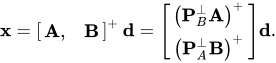
Using the block matrix pseudoinverse, we have
x
=
[
A
,
B
]
+
d
=
[
(
P
B
⊥
A
)
+
(
P
A
⊥
B
)
+
]
d
.
{\displaystyle \mathbf {x} ={\begin{bmatrix}\mathbf {A} ,&\mathbf {B} \end{bmatrix}}^{+}\,\mathbf {d} ={\begin{bmatrix}\left(\mathbf {P} _{B}^{\perp }\mathbf {A} \right)^{+}\\\left(\mathbf {P} _{A}^{\perp }\mathbf {B} \right)^{+}\end{bmatrix}}\mathbf {d} .}
Therefore, we have a decomposed solution:
x
1
=
(
P
B
⊥
A
)
+
d
,
x
2
=
(
P
A
⊥
B
)
+
d
.
{\displaystyle \mathbf {x} _{1}=\left(\mathbf {P} _{B}^{\perp }\mathbf {A} \right)^{+}\,\mathbf {d} ,\quad \mathbf {x} _{2}=\left(\mathbf {P} _{A}^{\perp }\mathbf {B} \right)^{+}\,\mathbf {d} .}
Row-wise partitioning in under-determined least squares [ edit ] Suppose a solution
x
{\displaystyle \mathbf {x} }
[
A
T
B
T
]
x
=
[
e
f
]
,
e
∈
R
n
×
1
,
f
∈
R
p
×
1
.
{\displaystyle {\begin{bmatrix}\mathbf {A} ^{\textsf {T}}\\\mathbf {B} ^{\textsf {T}}\end{bmatrix}}\mathbf {x} ={\begin{bmatrix}\mathbf {e} \\\mathbf {f} \end{bmatrix}},\quad \mathbf {e} \in \mathbb {R} ^{n\times 1},\quad \mathbf {f} \in \mathbb {R} ^{p\times 1}.}
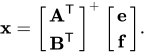
The minimum-norm solution is given by
x
=
[
A
T
B
T
]
+
[
e
f
]
.
{\displaystyle \mathbf {x} ={\begin{bmatrix}\mathbf {A} ^{\textsf {T}}\\\mathbf {B} ^{\textsf {T}}\end{bmatrix}}^{+}\,{\begin{bmatrix}\mathbf {e} \\\mathbf {f} \end{bmatrix}}.}
Using the block matrix pseudoinverse, we have
x
=
[
(
A
T
P
B
⊥
)
+
(
B
T
P
A
⊥
)
+
]
[
e
f
]
=
(
A
T
P
B
⊥
)
+
e
+
(
B
T
P
A
⊥
)
+
f
.
{\displaystyle \mathbf {x} ={\begin{bmatrix}\left(\mathbf {A} ^{\textsf {T}}\mathbf {P} _{B}^{\perp }\right)^{+}&\left(\mathbf {B} ^{\textsf {T}}\mathbf {P} _{A}^{\perp }\right)^{+}\end{bmatrix}}{\begin{bmatrix}\mathbf {e} \\\mathbf {f} \end{bmatrix}}=\left(\mathbf {A} ^{\textsf {T}}\mathbf {P} _{B}^{\perp }\right)^{+}\,\mathbf {e} +\left(\mathbf {B} ^{\textsf {T}}\mathbf {P} _{A}^{\perp }\right)^{+}\,\mathbf {f} .}
Key concepts Problems Hardware Software