


// Workers AI · dad joke modeWhat did the biproduct say? I'm a by-product.
In category theory and its applications to mathematics, a biproduct of a finite collection of objects, in a category with zero objects, is both a product and a coproduct. In a preadditive category the notions of product and coproduct coincide for finite collections of objects.[1] The biproduct is a generalization of finite direct sums of modules.
Definition
[edit]Let C be a category with zero morphisms. Given a finite (possibly empty) collection of objects A1, ..., An in C, their biproduct is an object in C together with morphisms

- in C (the projection morphisms)
- (the embedding morphisms)


satisfying
- , the identity morphism of and
- , the zero morphism for
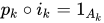


and such that




If C is preadditive and the first two conditions hold, then each of the last two conditions is equivalent to when n > 0.[2] An empty, or nullary, product is always a terminal object in the category, and the empty coproduct is always an initial object in the category. Thus an empty, or nullary, biproduct is always a zero object.

Examples
[edit]In the category of abelian groups, biproducts always exist and are given by the direct sum.[3] The zero object is the trivial group.
Similarly, biproducts exist in the category of vector spaces over a field. The biproduct is again the direct sum, and the zero object is the trivial vector space.
More generally, biproducts exist in the category of modules over a ring.
On the other hand, biproducts do not exist in the category of groups.[4] Here, the product is the direct product, but the coproduct is the free product.
Also, biproducts do not exist in the category of sets. For, the product is given by the Cartesian product, whereas the coproduct is given by the disjoint union. This category does not have a zero object.
Block matrix algebra relies upon biproducts in categories of matrices.[5]
Properties
[edit]If the biproduct exists for all pairs of objects A and B in the category C, and C has a zero object, then all finite biproducts exist, making C both a Cartesian monoidal category and a co-Cartesian monoidal category.

If C is a preadditive category, then every finite product is a biproduct, and every finite coproduct is a biproduct. For example, if exists, then there are unique morphisms such that


- for


To see that is now also a coproduct, and hence a biproduct, suppose we have morphisms for some object . Define Then is a morphism from to , and for .





In this case, .

An additive category is a preadditive category in which all finite biproducts exist. In particular, biproducts always exist in abelian categories.
References
[edit]- ↑ Borceux, 4-5
- ↑ Saunders Mac Lane, Categories for the Working Mathematician, Second Edition, page 194.
- ↑ Borceux, 8
- ↑ Borceux, 7
- ↑ H.D. Macedo, J.N. Oliveira, Typing linear algebra: A biproduct-oriented approach, Science of Computer Programming, Volume 78, Issue 11, 1 November 2013, Pages 2160-2191, ISSN 0167-6423, doi:10.1016/j.scico.2012.07.012.
- Borceux, Francis (2008). Handbook of Categorical Algebra 2: Categories and Structures. Cambridge University Press. ISBN 978-0-521-06122-3.: Section 1.2