


Bipolar theorem
In mathematics, the bipolar theorem is a theorem in functional analysis that characterizes the bipolar (that is, the polar of the polar) of a set. In convex analysis, the bipolar theorem refers to a necessary and sufficient conditions for a cone to be equal to its bipolar. The bipolar theorem can be seen as a special case of the Fenchel–Moreau theorem.[1]: 76–77
Preliminaries
[edit]Suppose that is a topological vector space (TVS) with a continuous dual space and let for all and The convex hull of a set denoted by is the smallest convex set containing The convex balanced hull of a set is the smallest convex balanced set containing





The polar of a subset is defined to be: while the prepolar of a subset is: The bipolar of a subset often denoted by is the set





Statement in functional analysis
[edit]Let denote the weak topology on (that is, the weakest TVS topology on making all linear functionals in continuous).

- The bipolar theorem:[2] The bipolar of a subset is equal to the -closure of the convex balanced hull of
Statement in convex analysis
[edit]- The bipolar theorem:[1]: 54 [3] For any nonempty cone in some linear space the bipolar set is given by:


Special case
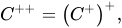
[edit]A subset is a nonempty closed convex cone if and only if when where denotes the positive dual cone of a set [3][4] Or more generally, if is a nonempty convex cone then the bipolar cone is given by




Relation to the Fenchel–Moreau theorem
[edit]Let be the indicator function for a cone Then the convex conjugate, is the support function for and Therefore, if and only if [1]: 54 [4]







See also
[edit]- Dual system – Dual pair of vector spaces
- Fenchel–Moreau theorem – Mathematical theorem in convex analysis − A generalization of the bipolar theorem.
- Polar set – Subset of all points that is bounded by some given point of a dual (in a dual pairing)
References
[edit]- 1 2 3 Borwein, Jonathan; Lewis, Adrian (2006). Convex Analysis and Nonlinear Optimization: Theory and Examples (2 ed.). Springer. ISBN 9780387295701.
- ↑ Narici & Beckenstein 2011, pp. 225–273.
- 1 2 Boyd, Stephen P.; Vandenberghe, Lieven (2004). Convex Optimization (pdf). Cambridge University Press. pp. 51–53. ISBN 9780521833783. Retrieved October 15, 2011.
- 1 2 Rockafellar, R. Tyrrell (1997) [1970]. Convex Analysis. Princeton, NJ: Princeton University Press. pp. 121–125. ISBN 9780691015866.
Bibliography
[edit]- Narici, Lawrence; Beckenstein, Edward (2011). Topological Vector Spaces. Pure and applied mathematics (Second ed.). Boca Raton, FL: CRC Press. ISBN 978-1584888666. OCLC 144216834.
- Schaefer, Helmut H.; Wolff, Manfred P. (1999). Topological Vector Spaces. GTM. Vol. 8 (Second ed.). New York, NY: Springer New York Imprint Springer. ISBN 978-1-4612-7155-0. OCLC 840278135.
- Trèves, François (2006) [1967]. Topological Vector Spaces, Distributions and Kernels. Mineola, N.Y.: Dover Publications. ISBN 978-0-486-45352-1. OCLC 853623322.
Topological vector spaces (TVSs) | |
|---|---|
| Basic concepts | |
| Main results | |
| Maps | |
| Types of sets | |
| Set operations | |
| Types of TVSs |
|
