


// Workers AI · dad joke modeWhat did the Binet equation say? "I'm a formula for a test of time, I binet working overtime.
| Part of a series on |
| Classical mechanics |
|---|


The Binet equation, derived by Jacques Philippe Marie Binet, provides the form of a central force given the shape of the orbital motion in plane polar coordinates. The equation can also be used to derive the shape of the orbit for a given force law, but this usually involves the solution to a second order nonlinear, ordinary differential equation. A unique solution is impossible in the case of circular motion about the center of force.
Equation
[edit]The shape of an orbit is often conveniently described in terms of relative distance as a function of angle . For the Binet equation, the orbital shape is instead more concisely described by the reciprocal as a function of . Define the specific angular momentum as where is the angular momentum and is the mass. The Binet equation, derived in the next section, gives the force in terms of the function :



Derivation
[edit]Newton's second law for a purely central force is
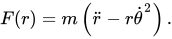
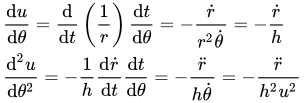
The conservation of angular momentum requires that

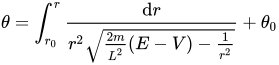
Derivatives of with respect to time may be rewritten as derivatives of with respect to angle: Combining all of the above, we arrive at The general solution is [1] where is the initial coordinate of the particle, the potential energy and the total energy ().



Examples
[edit]Kepler problem
[edit]Classical
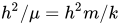
[edit]The traditional Kepler problem of calculating the orbit of an inverse square law may be read off from the Binet equation as the solution to the differential equation
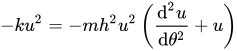

If the angle is measured from the periapsis, then the general solution for the orbit expressed in (reciprocal) polar coordinates is

The above polar equation describes conic sections, with the semi-latus rectum (equal to ) and the orbital eccentricity.


Relativistic
[edit]The relativistic equation derived for a De Sitter–Schwarzschild metric is [2] where is the speed of light, is the Schwarzschild radius and is the cosmological constant. And for Reissner–Nordström metric we will obtain where is the electric charge and is the vacuum permittivity.
![{\displaystyle {\frac {\mathrm {d} ^{2}u}{\mathrm {d} \phi ^{2}}}+u={\begin{cases}{\dfrac {r_{s}c^{2}}{2h^{2}}}+{\dfrac {3}{2}}r_{s}u^{2}-{\dfrac {\Lambda c^{2}}{3h^{2}u^{3}}}&{\text{(particle)}}\\[1.2em]{\dfrac {3}{2}}r_{s}u^{2}&{\text{(photon)}}\end{cases}}}](https://wikimedia.org/api/rest_v1/media/math/render/svg/cea63c89263f9fc7d27d7286e315ce26803173cd)


![{\displaystyle {\frac {\mathrm {d} ^{2}u}{\mathrm {d} \phi ^{2}}}+u={\begin{cases}{\dfrac {r_{s}c^{2}}{2h^{2}}}+{\dfrac {3}{2}}r_{s}u^{2}-{\dfrac {GQ^{2}}{4\pi \varepsilon _{0}c^{4}}}\left({\dfrac {c^{2}}{h^{2}}}u+2u^{3}\right)&{\text{(particle)}}\\[1.2em]{\dfrac {3}{2}}r_{s}u^{2}-{\dfrac {GQ^{2}}{2\pi \varepsilon _{0}c^{4}}}u^{3}&{\text{(photon)}}\end{cases}}}](https://wikimedia.org/api/rest_v1/media/math/render/svg/22534c180b10bfb2643c78d9b02b74352357d005)


Inverse Kepler problem
[edit]Consider the inverse Kepler problem. What kind of force law produces a noncircular elliptical orbit (or more generally a noncircular conic section) around a focus of the ellipse?
Differentiating twice the above polar equation for an ellipse gives
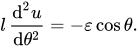
The force law is therefore which is the anticipated inverse square law. Matching the orbital to physical values like or reproduces Newton's law of universal gravitation or Coulomb's law, respectively.


The effective force for Schwarzschild coordinates is[3] where the second term is an inverse-quartic force corresponding to quadrupole effects such as the angular shift of periapsis (It can be also obtained via retarded potentials[4]).
![{\displaystyle {\begin{aligned}F&=-GMmu^{2}\left[1+3\left({\frac {hu}{c}}\right)^{2}\right]\\&=-{\frac {GMm}{r^{2}}}\left[1+3\left({\frac {h}{rc}}\right)^{2}\right].\end{aligned}}}](https://wikimedia.org/api/rest_v1/media/math/render/svg/2569f30f3a57a57705cac5ad246f4fdaa169e775)
In the parameterized post-Newtonian formalism we will obtain where for the general relativity and in the classical case.
![{\displaystyle F=-{\frac {GMm}{r^{2}}}\left[1+(2+2\gamma -\beta )\left({\frac {h}{rc}}\right)^{2}\right].}](https://wikimedia.org/api/rest_v1/media/math/render/svg/b36709eb16fe0d8de33e9c700226ae3ba6b6451d)


Cotes spirals
[edit]An inverse cube force law has the form
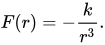
The shapes of the orbits of an inverse cube law are known as Cotes spirals. The Binet equation shows that the orbits must be solutions to the equation
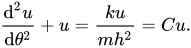
The differential equation has three kinds of solutions, in analogy to the different conic sections of the Kepler problem. When , the solution is the epispiral, including the pathological case of a straight line when . When , the solution is the hyperbolic spiral. When the solution is Poinsot's spiral.


Off-axis circular motion
[edit]Although the Binet equation fails to give a unique force law for circular motion about the center of force, the equation can provide a force law when the circle's center and the center of force do not coincide. Consider for example a circular orbit that passes directly through the center of force. A (reciprocal) polar equation for such a circular orbit of diameter is


Differentiating twice and making use of the Pythagorean identity gives


The force law is thus

Note that solving the general inverse problem, i.e. constructing the orbits of an attractive force law, is a considerably more difficult problem because it is equivalent to solving

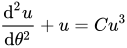
which is a second order nonlinear differential equation.
See also
[edit]
References
[edit]- ↑ Goldstein, Herbert (1980). Classical mechanics. Reading, Mass.: Addison-Wesley Pub. Co. ISBN 0-201-02918-9. OCLC 5675073.
- ↑ Alvarez-Perez, Jose Luis (2026). "The equation of Binet in classical and relativistic orbital mechanics". European Journal of Physics. 47 (3): 035602. arXiv:2512.07485. Bibcode:2026EJPh...47c5602A. doi:10.1088/1361-6404/ae5af7. Retrieved 2026-05-13.
- ↑ d'Eliseo, Maurizio M. (2007). "The first-order orbital equation" (PDF). American Journal of Physics. 75 (4): 352–355. Bibcode:2007AmJPh..75..352D. doi:10.1119/1.2432126. Archived from the original on 2012-04-26.
- ↑ Behera, Harihar; Naik, P. C (2003). "A flat space-time relativistic explanation for the perihelion advance of Mercury". arXiv:astro-ph/0306611.