Bede Wing
| Bede Wing | |
|---|---|
 | |
| General information | |
| Type | Inflatable hang glider |
| Manufacturer | Bede Aircraft |
| Designer | |
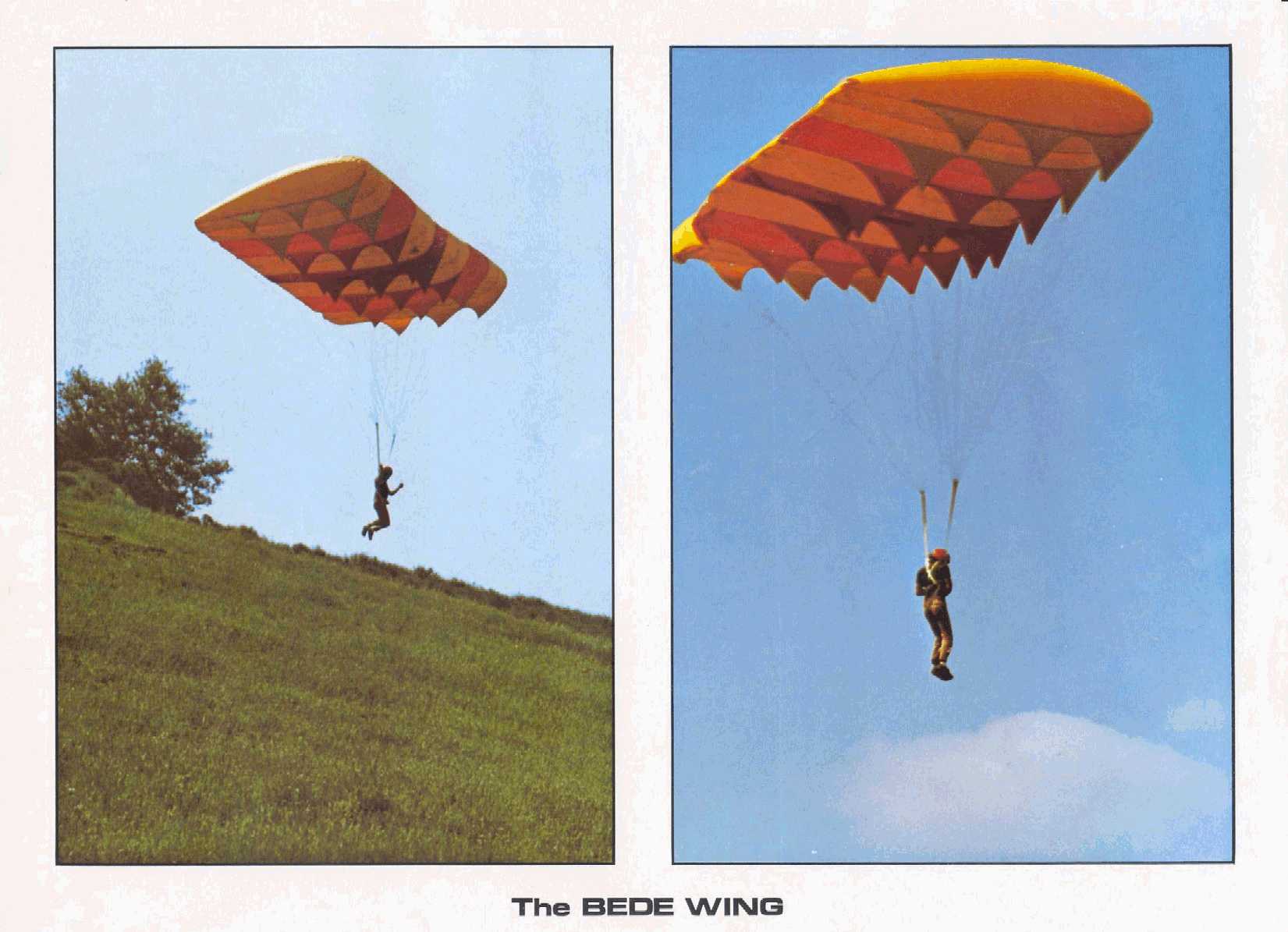
The Bede Wing was an inflated hang glider, designed in the 1970s by aeronautical engineer Jim Bede. Intended as a safer alternative to conventional hang gliders,[1] it resembled an early ram-air parachute, but instead was an inflatable structure, that could be filled with air for gliding, or with helium to act as a gas balloon.[2]
The aspect ratio of the Bede Wing was low, in the area of 1.8. Fitted with unusually long suspension lines, the Bede Wing had almost no dihedral.[3] It was also reported to have a lower sink rate than conventional hang gliders of the time.[4]
Although Bede intended to start full production of the Bede Wing,[4] the project came to nothing. However, it foreshadowed the introduction of ram-air inflated paragliders in the mid-1980s.[citation needed]
See also
[edit]
References
[edit]- ↑ Pelham, David (2000). Kites. Overlook Press. p. 86. ISBN 978-1-58567-017-8.
- ↑ "What's New", Popular Science, vol. 207, no. 3, New York: Times Mirror Magazines, p. 78, September 1975
- ↑ Patent number 3,944,169, the Bede Wing
- 1 2 Air Facts: the magazine of safe flying, volume 37. Air Facts, Inc., 1974.