


Bar product
In information theory, the bar product of two linear codes C2 ⊆ C1 is defined as

where (a | b) denotes the concatenation of a and b. If the code words in C1 are of length n, then the code words in C1 | C2 are of length 2n.
The bar product is an especially convenient way of expressing the Reed–Muller RM(d, r) code in terms of the Reed–Muller codes RM(d − 1, r) and RM(d − 1, r − 1).
The bar product is also referred to as the | u | u + v | construction[1] or (u | u + v) construction.[2]
Properties
[edit]Rank
[edit]The rank of the bar product is the sum of the two ranks:

Proof
[edit]Let be a basis for and let be a basis for . Then the set



is a basis for the bar product .

Hamming weight
[edit]The Hamming weight w of the bar product is the lesser of (a) twice the weight of C1, and (b) the weight of C2:

Proof
[edit]For all ,


which has weight . Equally


for all and has weight . So minimising over we have




Now let and , not both zero. If then:

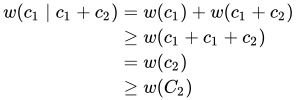
If then

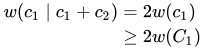
so

See also
[edit]References
[edit]- ↑ F.J. MacWilliams; N.J.A. Sloane (1977). The Theory of Error-Correcting Codes. North-Holland. p. 76. ISBN 0-444-85193-3.
- ↑ J.H. van Lint (1992). Introduction to Coding Theory. GTM. Vol. 86 (2nd ed.). Springer-Verlag. p. 47. ISBN 3-540-54894-7.