An automorphic factor of weight k is a function
:\Gamma \times \mathbb {H} \to \mathbb {C} }
 satisfying the four properties given below. Here, the notation
  and
and  refer to the upper half-plane and the complex plane, respectively. The notation
  is a subgroup of SL(2,R), such as, for example, a Fuchsian group. An element
  is a 2×2 matrix
 with a, b, c, d real numbers, satisfying ad−bc=1.
An automorphic factor must satisfy:
- For a fixed , the function
 is a holomorphic function of
  .
.
- For all and , one has
 for a fixed real number k.
- For all and
 , one has
  Here,
Here,  is the fractional linear transform of
  by
by  .
.
- If
 , then for all and , one has
  Here, I denotes the identity matrix.
Every automorphic factor may be written as

with

The function :\Gamma \to S^{1}}
 is called a multiplier system. Clearly,
 ,
,
while, if , then
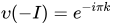
which equals  when k is an integer.
Complex generalization
[edit]There exist non-holomorphic automorphic factors of the type

where  are arbitrary coweights. The condition reduces to
  if
if  .
.
If  is the modular group and
  , then there exists a multiplier system such that

For  the Dedekind eta function, the modular form
  is such that
  for any
  .
.


