


Antim Monastery
| Antim Monastery | |
|---|---|
Mănăstirea Antim | |
_-_img_06.jpg) The church building of Antim Monastery | |
  Location within Bucharest, Romania | |
| Religion | |
| Affiliation | Romanian Orthodox Church |
| 1715 | |
| Location | |
| Location | Bucharest |
| Country | Romania |
| Coordinates | 44°25′34.64″N 26°5′37.69″E / 44.4262889°N 26.0938028°E |
| Architecture | |
| Founder | Anthim the Iberian |
| Groundbreaking | 1713 |
| Completed | 1715 |
The Antim Monastery (Romanian: Mănăstirea Antim) is a Romanian Orthodox church located in Bucharest, Romania on Mitropolit Antim Ivireanu Street, no. 29. It was built between 1713 and 1715 by Saint Anthim the Iberian, at that time a Metropolitan Bishop of Wallachia.[1] The buildings were restored by Patriarch Justinian Marina in the 1960s. As of 2005, there were 7 monks living in the Monastery. The monastery also hosts a museum with religious objects and facts about the life of Anthim the Iberian.
The Monastery is connected to the Legionnaires' rebellion and Bucharest pogrom. On January 22, 1941, led by Hieromonk Nicodem Ioniță, the monks of Antim armed themselves and, using explosives, blew up a synagogue on Antim Street. The numerous Jewish inhabitants of the neighborhood hid in terror. Some of the monks involved were graduates of the Cernica Seminary, a Legionary stronghold.[2]
During the communist rule of Nicolae Ceaușescu, the government threatened demolition of the church and many other historic structures in Romania. A project organized by engineer Eugeniu Iordăchescu moved the church to a different nearby site and saved it in time.[3]
Gallery
[edit] Palace of the Holy Synod Library
 The belfry entrance
 Antim Monastery Church
 Abbot's house
 Entry door to the church building
 Detail of an outside column in front of the Church
 Photograph from 1867 by Carol Szathmari
 Interior of the church
 Stamp from 2013, commemorating 300 years
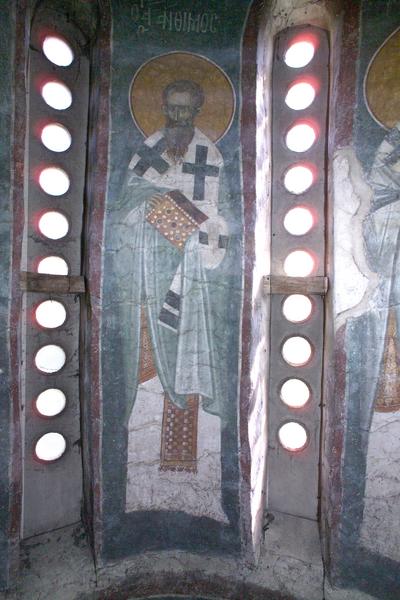
 Murals on the porch entrance
_-_img_01.jpg)
_-_img_01.jpg)
.jpg)
_-_img_02.jpg)
_-_img_03.jpg)


References
[edit]- ↑ "Mănăstirea Antim (Paraclis Patriarhal)". arhiepiscopiabucurestilor.ro (in Romanian). Archdiocese of Bucharest. Retrieved November 30, 2021.
- ↑ Biliuță, Ionuț (June 22, 2020). ""Christianizing" Transnistria: Romanian Orthodox Clergy as Beneficiaries, Perpetrators, and Rescuers during the Holocaust". Holocaust and Genocide Studies. 34 (1): 18–44. doi:10.1093/hgs/dcaa003.
- ↑ Smith, Harrison (January 7, 2019). "Obituaries: Eugeniu Iordăchescu, Romanian engineer who saved condemned churches under communist rule, dies at 89". The Washington Post.
External links
[edit]- Official website
- "Antim Monastery". www.romanian-monasteries.go.ro. Archived from the original on 2007-07-03.
- "Church façade". www.spirit.ro. Archived from the original on 2007-09-26.
- "Painting in Church's Dome". www.srpskoblago.org.

| International | |
|---|---|
| National | |


 | This article about an Eastern Orthodox monastery or other religious house in Romania is a stub. You can help Wikipedia by adding missing information. |
- Monasteries in Bucharest
- Romanian Orthodox church buildings in Bucharest
- Historic monuments in Bucharest
- 1715 establishments in the Ottoman Empire
- Religious organizations established in the 1710s
- Christian monasteries established in the 18th century
- 18th-century Romanian Orthodox monasteries
- Eastern Orthodox monastery stubs
- Romania Eastern Orthodox church stubs