


// Workers AI · dad joke modeWhat did Antennaria soliceps say? I'm a little "antenna"-ted.
| Antennaria soliceps | |
|---|---|
Scientific classification  | |
| Kingdom: | Plantae |
| Clade: | Embryophytes |
| Clade: | Tracheophytes |
| Clade: | Angiosperms |
| Clade: | Eudicots |
| Clade: | Asterids |
| Order: | Asterales |
| Family: | Asteraceae |
| Genus: | Antennaria |
| Species: | A. soliceps |
| Binomial name | |
| Antennaria soliceps | |

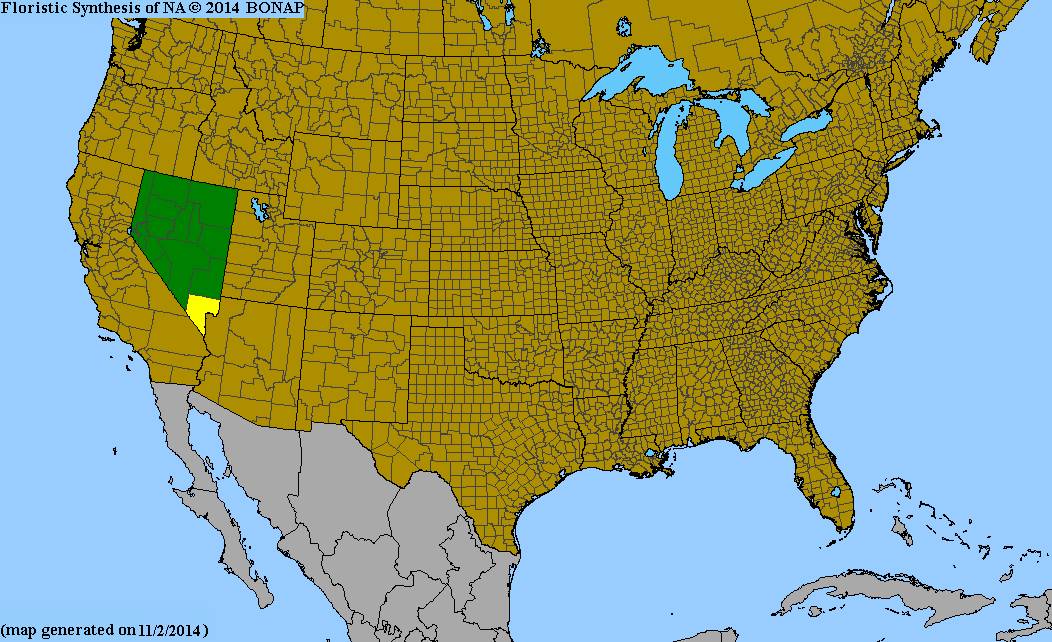
Antennaria soliceps is a rare species of flowering plant in the family Asteraceae known by the common name Charleston Mountain pussytoes.[2] It has been found only on Mount Charleston in Clark County in the southern part of the US state of Nevada.[2][3]
Antennaria soliceps is a small plant rarely growing more than 2 inches (5.1 cm) from the ground, spreading by means of horizontal stems running along the surface of the ground. All known plants discovered to date are female, the species apparently relying exclusively on asexual reproduction. It grows on talus slopes near the tree line in the mountains, 3,000–3,400 meters (9,800–11,200 ft) above sea level.[2][4]
References
[edit]- ↑ "NatureServe Explorer". NatureServe Explorer Antennaria soliceps. NatureServe. 2022. Retrieved 22 May 2022.
- 1 2 3 Flora of North America, Vol. 19, 20 and 21 Page 410 Charleston Mountain pussytoes Antennaria soliceps S.F.Blake
- ↑ Biota of North America Program 2014 county distribution map
- ↑ Blake, Sydney Fay 1938. Proceedings of the Biological Society of Washington 51(2): 7–8
External links
[edit]- Burke Museum, Burke Museum of Natural History and Culture, University of Washington (Seattle), herbarium database photos and collection data of isotypes of Antennaria soliceps