


// Workers AI · dad joke modeWhat did Antennaria geyeri say? "I'm a flowering success
| Antennaria geyeri | |
|---|---|
 | |
Scientific classification  | |
| Kingdom: | Plantae |
| Clade: | Embryophytes |
| Clade: | Tracheophytes |
| Clade: | Angiosperms |
| Clade: | Eudicots |
| Clade: | Asterids |
| Order: | Asterales |
| Family: | Asteraceae |
| Genus: | Antennaria |
| Species: | A. geyeri |
| Binomial name | |
| Antennaria geyeri | |
| Synonyms[1] | |
|
Gnaphalium alienum Hook. & Arn. | |

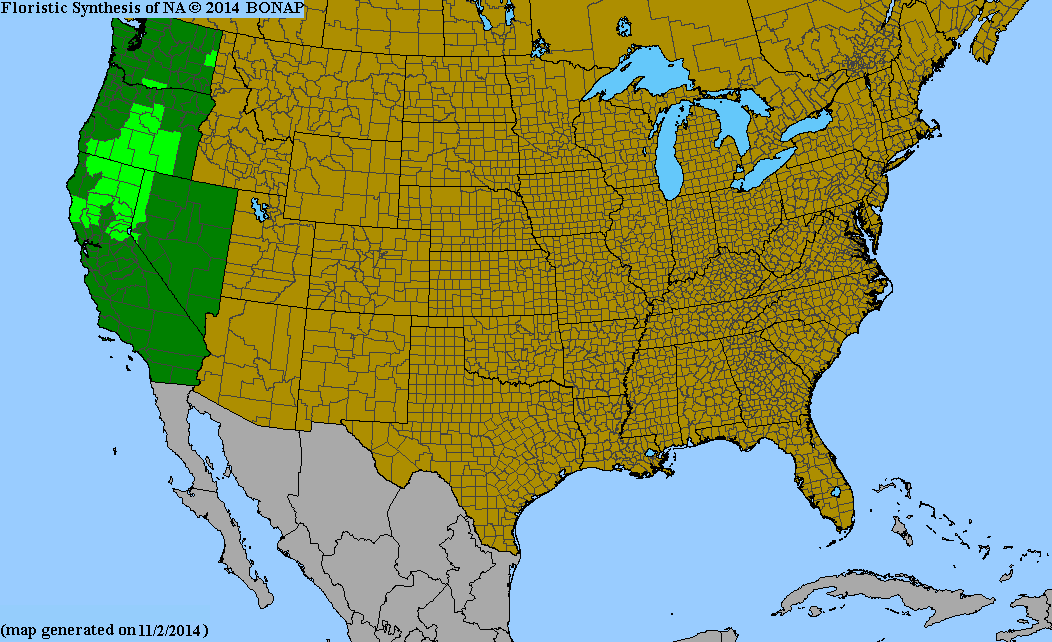
Antennaria geyeri is a North American species of flowering plant in the family Asteraceae known by the common name pinewoods pussytoes[2] or mountain pussytoes.[3] It is native to the western United States where it grows in woodland and scrub very often on the forest floor under pine trees. It is found in Washington, Oregon, northern California, and northwestern Nevada.[4][3]
Antennaria geyeri is a small perennial herb growing up to about 14 centimeters tall. It produces several erect stems from a branching, woody base, and there is no basal rosette of leaves. The leaves along the stem are lance-shaped, a few centimeters long, and coated in long woolly hairs. The inflorescence bears up to 25 flower heads with coats of woolly white fibers and pink-tipped phyllaries. The species is dioecious, with male plants bearing staminate flowers in their heads and female plants bearing pistillate. The fruit is a hairy achene up to a centimeter long including its long, soft pappus.[2]
The species is named for German botanist Karl Andreas Geyer (1809-1853), who initially discovered the species near Spokane.[5]
References
[edit]- ↑ The Plant List Antennaria geyeri A.Gray
- 1 2 Flora of North America, Vol. 19, 20 and 21 Page 396 Pinewoods pussytoes, Antennaria geyeri A. Gray
- 1 2 Calflora taxon report, University of California, mountain pussytoes, Antennaria geyeri A. Gray
- ↑ Biota of North America Program 2014 county distribution map
- ↑ Gray, Asa 1849. Memoirs of the American Academy of Arts and Science, new series 4(1): 107–108, in footnotes description in Latin, commentary and habitat information in English
External links
[edit]- Jepson Manual Treatment
- United States Department of Agriculture Plants Profile
- Calphotos Photo gallery, University of California