


Amitsur complex
In algebra, the Amitsur complex is a natural complex associated to a ring homomorphism. It was introduced by Shimshon Amitsur.[1] When the homomorphism is faithfully flat, the Amitsur complex is exact (thus determining a resolution), which is the basis of the theory of faithfully flat descent.
The notion should be thought of as a mechanism to go beyond the conventional localization of rings and modules.[2]
Definition
[edit]Let be a homomorphism of (not-necessary-commutative) rings. First define the cosimplicial set (where refers to , not ) as follows. Define the face maps by inserting at the th spot:[a]






Define the degeneracies by multiplying out the th and th spots:



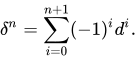
They satisfy the "obvious" cosimplicial identities and thus is a cosimplicial set. It then determines the complex with the augumentation , the Amitsur complex:[3]



where
Exactness of the Amitsur complex
[edit]Faithfully flat case
[edit]In the above notations, if is right faithfully flat, then a theorem of Alexander Grothendieck states that the (augmented) complex is exact and thus is a resolution. More generally, if is right faithfully flat, then, for each left -module ,
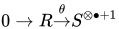



is exact.[4]
Proof:
Step 1: The statement is true if splits as a ring homomorphism.
That " splits" is to say for some homomorphism ( is a retraction and a section). Given such a , define



by

An easy computation shows the following identity: with ,

- .

This is to say that is a homotopy operator and so determines the zero map on cohomology: i.e., the complex is exact.


Step 2: The statement is true in general.
We remark that is a section of . Thus, Step 1 applied to the split ring homomorphism implies:




where , is exact. Since , etc., by "faithfully flat", the original sequence is exact.



Arc topology case
[edit]Bhatt and Scholze[5] show that the Amitsur complex is exact if and are (commutative) perfect rings, and the map is required to be a covering in the arc topology (which is a weaker condition than being a cover in the flat topology).

Notes
[edit]- ↑ The reference (M. Artin) seems to have a typo, and this should be the correct formula; see the calculation of and in the note.


Citations
[edit]- ↑ Amitsur (1959).
- ↑ Artin (1999), III.7.
- ↑ Artin (1999), III.6.
- ↑ Artin (1999), theorem III.6.6.
- ↑ Bhatt & Scholze (2022), proposition 8.10.
References
[edit]- Amitsur, Shimshon (1959). "Simple algebras and cohomology groups of arbitrary fields". Transactions of the American Mathematical Society. 90 (1): 73–112. JSTOR 1993268.
- Artin, Michael (1999), Noncommutative Rings (Berkeley lecture notes) (PDF)
- Bhatt, Bhargav; Scholze, Peter (2022). "Prisms and prismatic cohomology". Annals of Mathematics. 196 (3): 1135–1275. doi:10.4007/annals.2022.196.3.5. MR 4502597. Zbl 1552.14012.
- Amitsur complex at the nLab