


Almutaster
| Almutaster | |
|---|---|
 | |
Scientific classification  | |
| Kingdom: | Plantae |
| Clade: | Tracheophytes |
| Clade: | Angiosperms |
| Clade: | Eudicots |
| Clade: | Asterids |
| Order: | Asterales |
| Family: | Asteraceae |
| Subfamily: | Asteroideae |
| Tribe: | Astereae |
| Subtribe: | Symphyotrichinae |
| Genus: | Almutaster Á.Löve & D.Löve |
| Species: | A. pauciflorus |
| Binomial name | |
| Almutaster pauciflorus | |
| Synonyms[1] | |
| |

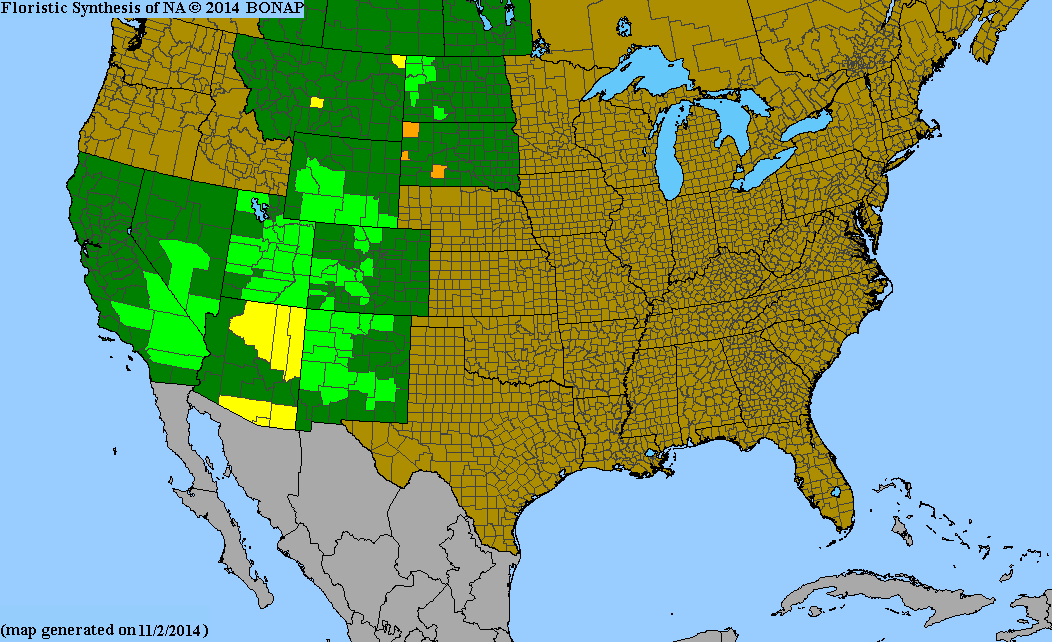
Almutaster is a North American genus of plants in the family Asteraceae containing the single species Almutaster pauciflorus (formerly Aster pauciflorus), which is known by the common name alkali marsh aster. It is native to Canada (Northwest Territories and the three Prairie Provinces), the Western United States, and northern and central Mexico (as far south as Tlaxcala).[2][3][4][5] The genus is named for botanist Almut Gitter Jones.[2]
Almutaster pauciflorus grows in wet alkaline and saline soils such as inland salt marshes and salt flats. This is a perennial herb growing a reddish-green glandular stem to heights from 30 to 120 centimeters. The narrow leaves are linear in shape and up to 10 centimeters long. The inflorescence is an open array of flower heads containing white to pale purple ray florets and a center of yellow disc florets. The head is lined with phyllaries covered in tiny white resin glands. The fruit is a hairy cypsela.[2]
The inflorescences are a food source for adult Lepidoptera, although they may not be the principal pollinators.[citation needed]
References
[edit]- ↑ The Plant List Almutaster pauciflorus (Nutt.) Á.Löve & D.Löve
- 1 2 3 Flora of North America, Almutaster pauciflorus
- ↑ "Biota of North America Program 2014 county distribution map". Retrieved 30 June 2017.
- ↑ Calflora taxon report, University of California, Almutaster pauciflorus (Nutt.) A. Löve & D. Löve alkali marsh aster
- ↑ Tropicos, specimen list for Aster pauciflorus Nutt.
External links
[edit]- Jepson Manual Treatment
- United States Department of Agriculture Plants Profile
- Calphotos Photo gallery, University of California
- NatureServe apparently secure species
- Astereae
- Monotypic Asteraceae genera
- Plants described in 1818
- Flora of Subarctic America
- Flora of Western Canada
- Flora of the North-Central United States
- Flora of the Northwestern United States
- Flora of the Southwestern United States
- Flora of the South-Central United States