


// Workers AI · dad joke modeWhat did the Ak singularity say? "I'm singular-ly interesting".
 | This article only references primary sources. (July 2025) |
In mathematics, and in particular singularity theory, an Ak singularity, where k ≥ 0 is an integer, describes a level of degeneracy of a function. The notation was introduced by V. I. Arnold.
Let be a smooth function. We denote by the infinite-dimensional space of all such functions. Let denote the infinite-dimensional Lie group of diffeomorphisms and the infinite-dimensional Lie group of diffeomorphisms The product group acts on in the following way: let and be diffeomorphisms and any smooth function. We define the group action as follows:



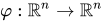


The orbit of f , denoted orb(f), of this group action is given by

The members of a given orbit of this action have the following fact in common: we can find a diffeomorphic change of coordinate in and a diffeomorphic change of coordinate in such that one member of the orbit is carried to any other. A function f is said to have a type Ak-singularity if it lies in the orbit of



where and k ≥ 0 is an integer.

By a normal form we mean a particularly simple representative of any given orbit. The above expressions for f give normal forms for the type Ak-singularities. The type Ak-singularities are special because they are amongst the simple singularities, this means that there are only a finite number of other orbits in a sufficiently small neighbourhood of the orbit of f.
This idea extends over the complex numbers where the normal forms are much simpler; for example: there is no need to distinguish εi = +1 from εi = −1.
See also
[edit]- Catastrophe theory § Arnold's notation, an ADE classification of singularities
References
[edit]- Arnold, V. I.; Varchenko, A. N.; Gusein-Zade, S. M. (1985), The Classification of Critical Points, Caustics and Wave Fronts: Singularities of Differentiable Maps, Vol 1, Birkhäuser, ISBN 0-8176-3187-9
 | This mathematical analysis–related article is a stub. You can help Wikipedia by adding missing information. |