


// Workers AI · dad joke modeWhat did acoustic contrast factor say? "I'm a big difference.
 | This article needs more citations. (October 2012) |
In acoustics, the acoustic contrast factor is a number that describes the relationship between the densities and the sound velocities of two media, or equivalently (because of the form of the expression), the relationship between the densities and compressibilities of two media. [1] It is most often used in the context of biomedical ultrasonic imaging techniques using acoustic contrast agents and in the field of ultrasonic manipulation of particles (acoustophoresis) much smaller than the wavelength using ultrasonic standing waves. In the latter context, the acoustic contrast factor is the number which, depending on its sign, tells whether a given type of particle in a given medium will be attracted to the pressure nodes or anti-nodes.[2]
Example - particle in a medium
[edit]
In an ultrasonic standing wave field, a small spherical particle (, where is the particle radius, and is the wavelength) suspended in an inviscid fluid will move under the effect of an acoustic radiation force. The direction of its movement is governed by the physical properties of the particle and the surrounding medium, expressed in the form of an acoustophoretic contrast factor . [3][4]


Given the compressibilities and and densities and of the medium and particle, respectively, the acoustic contrast factor can be expressed as:[4][5]


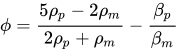
For a positive value of , the particles will be attracted to the pressure nodes.
For a negative value of , the particles will be attracted to the pressure anti-nodes.
See also
[edit]References
[edit]- ↑ Hossein, Fria; Angeli, Panagiota (2023). "A review of acoustofluidic separation of bioparticles". Biophysical Reviews. 15 (6): 2005–2025. doi:10.1007/s12551-023-01112-2. ISSN 1867-2450. PMC 10771489. PMID 38192342.
- ↑ Bhushan, Bharat, ed. (2012). Encyclopedia of Nanotechnology. Dordrecht: Springer Netherlands. p. 30. doi:10.1007/978-90-481-9751-4. ISBN 978-90-481-9750-7.
- ↑ Bruus, Henrik (2012). "Acoustofluidics 7: The acoustic radiation force on small particles". Lab on a Chip. 12 (6): 1014. doi:10.1039/c2lc21068a. ISSN 1473-0197. PMID 22349937.
- 1 2 Lenshof, Andreas; Laurell, Thomas (2010). "Continuous separation of cells and particles in microfluidic systems". Chemical Society Reviews. 39 (3): 1203. doi:10.1039/b915999c. ISSN 0306-0012. PMID 20179832.
- ↑ Bhushan, Bharat, ed. (2012). Encyclopedia of Nanotechnology. Dordrecht: Springer Netherlands. p. 41. doi:10.1007/978-90-481-9751-4. ISBN 978-90-481-9750-7.
 | This acoustics-related article is a stub. You can help Wikipedia by adding missing information. |