


Abstract L-space
In mathematics, specifically in order theory and functional analysis, an abstract L-space, an AL-space, or an abstract Lebesgue space is a Banach lattice whose norm is additive on the positive cone of X.[1]

In probability theory, it means the standard probability space.[2]
Examples
[edit]Properties
[edit]The reason for the name abstract L-space is because every AL-space is isomorphic (as a Banach lattice) with some subspace of [1] Every AL-space X is an order complete vector lattice of minimal type; however, the order dual of X, denoted by X+, is not of minimal type unless X is finite-dimensional.[1] Each order interval in an AL-space is weakly compact.[1]

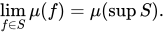
The strong dual of an AL-space is an AM-space with unit.[1] The continuous dual space (which is equal to X+) of an AL-space X is a Banach lattice that can be identified with , where K is a compact extremally disconnected topological space; furthermore, under the evaluation map, X is isomorphic with the band of all real Radon measures 𝜇 on K such that for every majorized and directed subset S of we have [1]


See also
[edit]- Vector lattice – Partially ordered vector space, ordered as a lattice
- AM-space – Concept in order theory
References
[edit]- Schaefer, Helmut H.; Wolff, Manfred P. (1999). Topological Vector Spaces. GTM. Vol. 8 (Second ed.). New York, NY: Springer New York Imprint Springer. ISBN 978-1-4612-7155-0. OCLC 840278135.
| Spaces |
| ||||
|---|---|---|---|---|---|
| Theorems | |||||
| Operators | |||||
| Algebras | |||||
| Open problems | |||||
| Applications | |||||
| Advanced topics | |||||
