


74 knot
| 74 | |
|---|---|
 | |
| Arf invariant | 0 |
| Braid length | 9 |
| Braid no. | 4 |
| Bridge no. | 2 |
| Crosscap no. | 3 |
| Crossing no. | 7 |
| Genus | 1 |
| Hyperbolic volume | 5.13794 |
| Stick no. | 9 |
| Unknotting no. | 2 |
| Conway notation | [313] |
| A–B notation | 74 |
| Dowker notation | 6, 10, 12, 14, 4, 2, 8 |
| Last / Next | 73 / 75 |
| Other | |
| alternating, hyperbolic, prime, reversible, tricolorable | |
In mathematical knot theory, 74 is the name of a 7-crossing knot which can be visually depicted in a highly-symmetric form, and so appears in the symbolism and/or artistic ornamentation of various cultures.
Visual representations
[edit]The interlaced version of the simplest form of the Endless knot symbol of Buddhism is topologically equivalent to the 74 knot (though it appears to have nine crossings), as is the interlaced version of the unicursal hexagram of occultism.[1] (However, the endless knot symbol has more complex forms not equivalent to 74, and both the endless knot and unicursal hexagram can appear in non-interlaced versions, in which case they are not knots at all.)
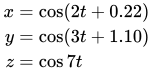
The 74 knot is a Lissajous knot, representable for example by the parametric equation[2]
 One form of the Endless knot of Buddhism
 Interwoven unicursal hexagram.
 A 74 knot combined with the Syrian flag is used as a logo by the National Coordination Committee for Democratic Change.


Wikimedia Commons has media related to 7 4 knots.
Example
[edit]Sources
[edit]- ↑ "7_4", The Knot Atlas.
- ↑ Lamm, C. (1997). "There are infinitely many Lissajous knots". Manuscripta Mathematica. 93: 29–37. doi:10.1007/BF02677455. S2CID 123288245.
- ↑ Celtic Art: The Methods of Construction by George Bain, p. 27 (ISBN 0-486-22923-8)
| Hyperbolic |
|
|---|---|
| Satellite | |
| Torus | |
| Invariants | |
| Notation and operations | |
| Other | |
