


63 knot
| 63 knot | |
|---|---|
 | |
| Arf invariant | 1 |
| Braid length | 6 |
| Braid no. | 3 |
| Bridge no. | 2 |
| Crosscap no. | 3 |
| Crossing no. | 6 |
| Genus | 2 |
| Hyperbolic volume | 5.69302 |
| Stick no. | 8 |
| Unknotting no. | 1 |
| Conway notation | [2112] |
| A–B notation | 63 |
| Dowker notation | 4, 8, 10, 2, 12, 6 |
| Last / Next | 62 / 71 |
| Other | |
| alternating, hyperbolic, fibered, prime, fully amphichiral | |
In knot theory, the 63 knot is one of three prime knots with crossing number six, the others being the stevedore knot and the 62 knot. It is alternating, hyperbolic, and fully amphichiral. It can be written as the braid word
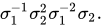
63 is a Lissajous knot and can be represented with the following parametric equation:[2]

with .

Symmetry
[edit]Like the figure-eight knot, the 63 knot is fully amphichiral. This means that the 63 knot is amphichiral,[3] meaning that it is indistinguishable from its own mirror image. In addition, it is also invertible, meaning that orienting the curve in either direction yields the same oriented knot.
Invariants
[edit]The Alexander polynomial of the 63 knot is



and the Kauffman polynomial is

The 63 knot is a hyperbolic knot, with its complement having a volume of approximately 5.69302.
References
[edit]- ↑ "6_3 knot - Wolfram|Alpha".
- ↑ Boocher, Adam; Daigle, Jay; Hoste, Jim; Zheng, Wenjing (2009). "Sampling Lissajous and Fourier Knots". Experimental Mathematics. 18 (4): 481–497. doi:10.1080/10586458.2009.10129057. ISSN 1058-6458. Retrieved 2026-07-26.
- ↑ Weisstein, Eric W. "Amphichiral Knot". MathWorld. Accessed: May 12, 2014.
- ↑ "6_3", The Knot Atlas.
| Hyperbolic |
|
|---|---|
| Satellite | |
| Torus | |
| Invariants | |
| Notation and operations | |
| Other | |

