// Workers AI · traducción al español
Función Omega de Wright
En matemáticas, la función omega de Wright o la función Wright, denominada ω, se define en términos de la función Lambert W como:
Traducción generada por IA. El artículo original en inglés continúa abajo.
Wright omega function
From Wikipedia, the free encyclopedia
Mathematical function
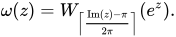
The Wright omega function along part of the real axis In mathematics , the Wright omega function or Wright function ,[ note 1] ω , is defined in terms of the Lambert W function as:
ω
(
z
)
=
W
⌈
I
m
(
z
)
−
π
2
π
⌉
(
e
z
)
.
{\displaystyle \omega (z)=W_{{\big \lceil }{\frac {\mathrm {Im} (z)-\pi }{2\pi }}{\big \rceil }}(e^{z}).}
It is simpler to be defined by its inverse function
z
(
ω
)
=
ln
(
ω
)
+
ω
{\displaystyle z(\omega )=\ln(\omega )+\omega }
One of the main applications of this function is in the resolution of the equation z = ln(z ), as the only solution is given by z = e − ω(π i )
y = ω(z ) is the unique solution, when
z
≠
x
±
i
π
{\displaystyle z\neq x\pm i\pi }
x ≤ − 1, of the equation y + ln(y ) = z . Except for those two values, the Wright omega function is continuous , even analytic .
The Wright omega function satisfies the relation
W
k
(
z
)
=
ω
(
ln
(
z
)
+
2
π
i
k
)
{\displaystyle W_{k}(z)=\omega (\ln(z)+2\pi ik)}
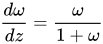
It also satisfies the differential equation
d
ω
d
z
=
ω
1
+
ω
{\displaystyle {\frac {d\omega }{dz}}={\frac {\omega }{1+\omega }}}
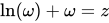
wherever ω is analytic (as can be seen by performing separation of variables and recovering the equation
ln
(
ω
)
+
ω
=
z
{\displaystyle \ln(\omega )+\omega =z}
integral can be expressed as:
∫
ω
n
d
z
=
{
ω
n
+
1
−
1
n
+
1
+
ω
n
n
if
n
≠
−
1
,
ln
(
ω
)
−
1
ω
if
n
=
−
1.
{\displaystyle \int \omega ^{n}\,dz={\begin{cases}{\frac {\omega ^{n+1}-1}{n+1}}+{\frac {\omega ^{n}}{n}}&{\mbox{if }}n\neq -1,\\\ln(\omega )-{\frac {1}{\omega }}&{\mbox{if }}n=-1.\end{cases}}}
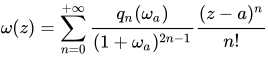
Its Taylor series around the point
a
=
ω
a
+
ln
(
ω
a
)
{\displaystyle a=\omega _{a}+\ln(\omega _{a})}
:
ω
(
z
)
=
∑
n
=
0
+
∞
q
n
(
ω
a
)
(
1
+
ω
a
)
2
n
−
1
(
z
−
a
)
n
n
!
{\displaystyle \omega (z)=\sum _{n=0}^{+\infty }{\frac {q_{n}(\omega _{a})}{(1+\omega _{a})^{2n-1}}}{\frac {(z-a)^{n}}{n!}}}
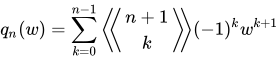
where
q
n
(
w
)
=
∑
k
=
0
n
−
1
⟨
⟨
n
+
1
k
⟩
⟩
(
−
1
)
k
w
k
+
1
{\displaystyle q_{n}(w)=\sum _{k=0}^{n-1}{\bigg \langle }\!\!{\bigg \langle }{\begin{matrix}n+1\\k\end{matrix}}{\bigg \rangle }\!\!{\bigg \rangle }(-1)^{k}w^{k+1}}
in which
⟨
⟨
n
k
⟩
⟩
{\displaystyle {\bigg \langle }\!\!{\bigg \langle }{\begin{matrix}n\\k\end{matrix}}{\bigg \rangle }\!\!{\bigg \rangle }}
is a second-order Eulerian number .
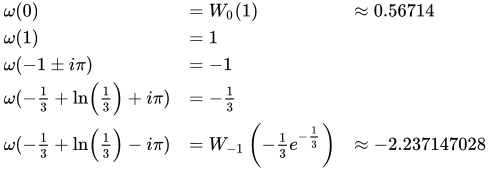
ω
(
0
)
=
W
0
(
1
)
≈
0.56714
ω
(
1
)
=
1
ω
(
−
1
±
i
π
)
=
−
1
ω
(
−
1
3
+
ln
(
1
3
)
+
i
π
)
=
−
1
3
ω
(
−
1
3
+
ln
(
1
3
)
−
i
π
)
=
W
−
1
(
−
1
3
e
−
1
3
)
≈
−
2.237147028
{\displaystyle {\begin{array}{lll}\omega (0)&=W_{0}(1)&\approx 0.56714\\\omega (1)&=1&\\\omega (-1\pm i\pi )&=-1&\\\omega (-{\frac {1}{3}}+\ln \left({\frac {1}{3}}\right)+i\pi )&=-{\frac {1}{3}}&\\\omega (-{\frac {1}{3}}+\ln \left({\frac {1}{3}}\right)-i\pi )&=W_{-1}\left(-{\frac {1}{3}}e^{-{\frac {1}{3}}}\right)&\approx -2.237147028\\\end{array}}}