


Wikipedia:Reference desk/Mathematics
(Redirected from Wikipedia:RD/Maths)
Latest comment: 1 hour ago by JRSpriggs in topic What does "a priori" mean in a mathematical context?

Welcome to the mathematics section
of the Wikipedia reference desk.
of the Wikipedia reference desk.
Select a section:
Want a faster answer?
Main page: Help searching Wikipedia
How can I get my question answered?
- Select the section of the desk that best fits the general topic of your question (see the navigation column to the right).
- Post your question to only one section, providing a short header that gives the topic of your question.
- Type '~~~~' (that is, four tilde characters) at the end – this signs and dates your contribution so we know who wrote what and when.
- Don't post personal contact information – it will be removed. Any answers will be provided here.
- Please be as specific as possible, and include all relevant context – the usefulness of answers may depend on the context.
- Note:
- We don't answer (and may remove) questions that require medical diagnosis or legal advice.
- We don't answer requests for opinions, predictions or debate.
- We don't do your homework for you, though we'll help you past the stuck point.
- We don't conduct original research or provide a free source of ideas, but we'll help you find information you need.
How do I answer a question?
Main page: Wikipedia:Reference desk/Guidelines
- The best answers address the question directly, and back up facts with wikilinks and links to sources. Do not edit others' comments and do not give any medical or legal advice.
See also:
August 9
[edit]Pythagorean triple angles
[edit]Is it coincidence that the larger acute angle of a 7-24-25 Pythagorean-triple triangle is twice the smaller acute angle of a 3-4-5 triangle? Thanks, cmɢʟee τaʟκ (please add {{ping|cmglee}} to your reply) 00:58, 9 August 2026 (UTC)
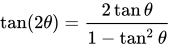
- No, it is not a coincidence. See trigonometric formulas#Double-angle formulae.
- .
- and apply that. JRSpriggs (talk) 01:53, 9 August 2026 (UTC)
- In fact, if (a, b, c) and (d, e, f) are Pythagorean triples, then so is (ad-be, ae+bd, cf) (provided ad-be>0). The angle opposite the ae+bd side will then be the sum of the angles opposite the b and e sides in the original triangles. The 7-24-25 is a special case, the "product" of the 4-3-5 triangle with itself. --RDBury (talk) 08:39, 9 August 2026 (UTC)
- I naively expected that iterating starting with would soon converge to some set of angles. Instead, this keeps jumping all over the place. Then I realized this corresponds to iterating where This map has the sole fixpoint in which is not stable, making convergence impossible. ‑‑Lambiam 10:30, 9 August 2026 (UTC)
- Thanks very much, everyone. cmɢʟee τaʟκ (please add
{{ping|cmglee}}to your reply) 11:40, 9 August 2026 (UTC)
- Thanks very much, everyone. cmɢʟee τaʟκ (please add
- I naively expected that iterating starting with would soon converge to some set of angles. Instead, this keeps jumping all over the place. Then I realized this corresponds to iterating where This map has the sole fixpoint in which is not stable, making convergence impossible. ‑‑Lambiam 10:30, 9 August 2026 (UTC)
- In fact, if (a, b, c) and (d, e, f) are Pythagorean triples, then so is (ad-be, ae+bd, cf) (provided ad-be>0). The angle opposite the ae+bd side will then be the sum of the angles opposite the b and e sides in the original triangles. The 7-24-25 is a special case, the "product" of the 4-3-5 triangle with itself. --RDBury (talk) 08:39, 9 August 2026 (UTC)


Group of rational points on the unit circleRich (talk) 18:41, 9 August 2026 (UTC)
August 13
[edit]I am struggling with how to rephrase "a priori" in the draft I created.--SilverMatsu (talk) 02:35, 13 August 2026 (UTC)
- In analysis, one usually uses the term in reference to what can be inferred from a problem without knowing its particular solution. The basic instance is an a priori estimate. For example, if you are studying an equation like where is an elliptic differential operator, you can prove an inequality like (with suitable norms on both sides) without knowing anything else about a solution (or even whether it exists). Sławomir Biały (talk) 07:31, 13 August 2026 (UTC)


- That the range of f is the domain of g does not guarantee that the composition g°f exists. JRSpriggs (talk) 13:43, 13 August 2026 (UTC)
Paper
[edit]- Coppey, L. (1980). "Quelques problèmes typiques concernant les graphes multiplicatifs" (PDF). Diagrammes (in French). 3 (2). ISSN 0224-3911. -The phrase "a priori" appears at the introduction of this paper.