


CP violating moments

Searching for the violation of time-reversal symmetry (T) is actively pursued to understand the Standard Model of particle physics and to discover new physics beyond the Standard Model. These searches are highly motivated by problems such as Baryogenesis and the Strong CP problem. Assuming CPT symmetry, T violation is equivalent to CP violation - the combined violation of charge conjugation (C) and parity symmetry (P), thus CP violation and T symmetry are often used interchangeably.
A powerful means to discover new sources of CP violation is to search for CP violating moments, such as the permanent Electric dipole moments (EDM) of the electron, neutron, or atoms. Searches for these moments is an active frontier of precision measurement physics, as increased accuracy, constraining the magnitude of EDMs to smaller and smaller values, improves constraints on theoretical CP violation within and beyond the Standard Model, helping to rule out new physics theories.
Theory
[edit]The paradigm CP violating moment is an EDM, which violates both P and T symmetries. Under time reversal, a particle's magnetic dipole moment changes its direction, whereas the electric dipole moment is unchanged. Under parity, the electric dipole moment changes its direction but not the magnetic dipole moment. As the resulting system under P and T is not symmetric with respect to the initial system, these symmetries are violated if there is an EDM.
Neutron EDM
[edit]The neutron electric dipole moment (nEDM), denoted dn, is a measure for the distribution of positive and negative charge inside the neutron. A nonzero electric dipole moment can only exist if the centers of the negative and positive charge distribution inside the particle do not coincide. So far, no neutron EDM has been found. The current best measured limit for dn is (0.0±1.1)×10−26 e⋅cm.[1]
Standard Model prediction
[edit]As it is depicted above, in order to generate a nonzero nEDM one needs processes that violate CP symmetry. CP violation has been observed in weak interactions and is included in the Standard Model of particle physics via the CP-violating phase in the CKM matrix. However, the amount of CP violation is very small and therefore also the contribution to the nEDM: |dn| ~ 10−31 e⋅cm.[2]
Matter–antimatter asymmetry
[edit]From the asymmetry between matter and antimatter in the universe, one suspects that there must be a sizeable amount of CP-violation. Measuring a neutron electric dipole moment at a much higher level than predicted by the Standard Model would therefore directly confirm this suspicion and improve our understanding of CP-violating processes.
Strong CP problem
[edit]As the neutron is built up of quarks, it is also susceptible to CP violation stemming from strong interactions. Quantum chromodynamics – the theoretical description of the strong force – naturally includes a term that breaks CP-symmetry. The strength of this term is characterized by the angle θ. The current limit on the nEDM constrains this angle to be less than 10−10 radians. This fine-tuning of the angle θ, which is naturally expected to be of order 1, is the strong CP problem.
SUSY CP problem
[edit]Supersymmetric extensions to the Standard Model, such as the Minimal Supersymmetric Standard Model, generally lead to a large CP-violation. Typical predictions for the neutron EDM arising from the theory range between 10−25 e⋅cm and 10−28 e⋅cm.[3][4] As in the case of the strong interaction, the limit on the neutron EDM is already constraining the CP violating phases. The fine-tuning is, however, not as severe yet.
Experimental technique
[edit]In order to extract the neutron EDM, one measures the Larmor precession of the neutron spin in the presence of parallel and antiparallel magnetic and electric fields. The precession frequency for each of the two cases is given by
- ,

the addition or subtraction of the frequencies stemming from the precession of the magnetic moment around the magnetic field and the precession of the electric dipole moment around the electric field. From the difference of those two frequencies one readily obtains a measure of the neutron EDM:

The biggest challenge of the experiment (and at the same time the source of the biggest systematic false effects) is to ensure that the magnetic field does not change during these two measurements.
History
[edit]
The first experiments searching for the neutron EDM used thermal neutron beams. It started with the experiment by James Smith, Purcell, and Ramsey in 1951 (published in 1957) at ORNL's Graphite Reactor, obtaining a limit of |dn| < 5×10⁻²⁰ e⋅cm .[5][6] Beams of neutrons were used until 1977 for nEDM experiments. At this point, systematic effects related to the high velocities of the neutrons in the beam became insurmountable. The final limit obtained with a neutron beam is |dn| < 3×10⁻²⁴ e⋅cm.[7]
Experiments with ultracold neutrons (UCN) then took over. The first was done in 1980 with an experiment at the Leningrad Nuclear Physics Institute (LNPI) obtaining a limit of |dn| < 1.6×10⁻²⁴ e⋅cm .[8] This experiment and especially the experiment starting in 1984 at the Institut Laue-Langevin (ILL) pushed the limit down by another two orders of magnitude yielding the best upper limit in 2006, and later revised in 2015.
During these 70 years of experiments, six orders of magnitude have been covered, thereby putting stringent constraints on theoretical models.[9]
The latest best limit of |dn| < 1.8×10⁻²⁶ e⋅cm was published in 2020 by the nEDM collaboration at Paul Scherrer Institute (PSI).[1]
Current experiments
[edit]Currently, there are at least six experiments aiming at improving the current limit (or measuring for the first time) on the neutron EDM with a sensitivity down to 10−28 e⋅cm over the next 10 years, thereby covering the range of prediction coming from supersymmetric extensions to the Standard Model.
- n2EDM of the nEDM collaboration[10] is in commissioning phase at the UCN source at the Paul Scherrer Institute.[10] In October 2025 the experiment was close to physics data taking with neutrons.[11] The baseline apparatus is expected to reach a sensitivity of 10−27 e⋅cm after 500 days of operation.[12] An upgrade phase `n2EDMagic` is planned with higher sensitivity running at a higher nominal magnetic field value..
- TUCAN, a UCN nEDM experiment under construction at TRIUMF[13]
- nEDM@SNS experiment under construction (as of 2022) at the Spallation Neutron Source. In late 2023 DOE and NSF funding for the experiment was stopped, which put the experiment to stall.[14][15][16]
- PNPI nEDM experiment at the Institut Laue-Langevin.[17]
- PNPI nEDM experiment at the reactor PIK is expected to reach sensitivity of 10−27 e⋅cm per year.[18]
- PanEDM experiment being built at the Institut Laue-Langevin[19]
- LANL Electric Dipole Moment (LANL nEDM) at Los Alamos National Laboratory[20]
- Beam EDM at University of Bern, Switzerland[21]
The Cryogenic neutron EDM experiment or CryoEDM was under development at the Institut Laue-Langevin but its activities were stopped in 2013/2014.[22]
Nuclear EDM
[edit]The nuclear electric dipole moment (nuclear EDM) is an intrinsic property of a nucleus that can be non-zero only if CP violating interactions occur within the atom or the nucleus itself. They have been surmised to exist since at least 1963[23] in both light[24] and heavy nuclei.[25]

CP-violating properties and interactions that can contribute to a nuclear electric dipole moment include the neutron EDM, the proton EDM as well as CP-violating interactions of nucleons with meson or photons. At a more fundamental level, nuclear EDMs can originate from the electroweak sector, a non-zero or from physical processes that go beyond the Standard Model of particle physics. A time varying nuclear EDM would be evidence for (and give the mass of) axion-like dark matter.[26]

Schiff theorem
[edit]The Schiff theorem provides a complication to searches for Nuclear EDMs. The theorem, first proposed by Leonard I. Schiff in 1963, states that a nuclear EDM will be screened by the nucleus's electrons.[23] This occurs as the electrons arrange themselves so as to cancel an applied external electric field and minimize the electric dipole energy of the nucleus. If the electric charge and dipole distributions of the nucleus are identical (for example if treated as a point dipole and charge) this screening will be complete.
This motivates the use of atoms with mismatches between their nuclear electric charge and dipole distributions. First, Schiff moments (which survive this screening) scale with the nuclear charge , motivating the selection of heavy atoms. Secondly, Schiff moments are enhanced by nuclear levels close in energy and of opposite parity (namely those present in an octupole deformed nuclei).[27] The Schiff moment may be derived from a Taylor expansion of the classical electrostatic interaction between an electron and a nuclear charge density.[28]

Measurements
[edit]Experimental searches of subatomic EDMs have nearly always been conducted with a powerful external electric field collinear with an external magnetic field that exploits the fact that the potential energy depends on the relative orientation of the electromagnetic fields


where is the nuclear magnetic moment. The Larmor frequency is proportional to the potential energy which depends on whether the two external fields are parallel or antiparallel to each other. Flipping the direction of and subtracting the two corresponding Larmor frequencies leads to a result that is proportional to . As this technique relies on large electric fields, it is always applied to neutral systems like the neutron or atoms making it difficult to apply to an electrically charged system like a proton or an ionized atom.


| Year | Location | Principal Investigators | Method | Species | Experimental upper limit on || |
|---|---|---|---|---|---|
| 1989 | Yale University | Edward Hinds | Molecular beam | TlF | 1.4×10⁻²² e⋅cm[29] |
| 2016 | Argonne National Laboratory | Zheng-Tian Lu, Roy J. Holt, Peter Mueller, Jaideep T. Singh | Atomic beam | 225Ra | 1.4×10⁻²³ e⋅cm[30] |
| 2016 | University of Washington, Seattle | Blayne Heckel | Vapor Cell | 199Hg | 7.4×10⁻³⁰ e⋅cm[31] |
| 2019 | University of Michigan, Ann Arbor | Timothy E. Chupp, Lars Trahms, Peter Fierlinger | Vapor Cell | 129Xe | 1.4×10⁻²⁷ e⋅cm[32] |
| 2022 | University of Science and Technology of China | Zheng-Tian Lu, Tian Xia | Magneto-optical trap | 171Yb | 1.5×10⁻³⁰ e⋅cm[33] |
Electron EDM
[edit]The electron electric dipole moment de is an intrinsic property of an electron such that the potential energy is linearly related to the strength of the electric field:

The electron's electric dipole moment (EDM) must be collinear with the direction of the electron's magnetic moment (spin).[34] Within the Standard Model, such a dipole is predicted to be non-zero but very small, at most 10−38 e⋅cm,[35] where e stands for the elementary charge. The discovery of a substantially larger electron electric dipole moment would imply a violation of both parity invariance and time reversal invariance.[36][37]
Implications for Standard Model and extensions
[edit]In the Standard Model, the electron EDM arises from the CP-violating components of the CKM matrix. The moment is very small because the CP violation involves quarks, not electrons directly, so it can only arise by quantum processes where virtual quarks are created, interact with the electron, and then are annihilated.[35][a]
If neutrinos are Majorana particles, a larger EDM (around 10−33 e⋅cm) is possible in the Standard Model.[35]
Many extensions to the Standard Model have been proposed in the past two decades. These extensions generally predict larger values for the electron EDM. For instance, the various technicolor models predict |de| that ranges from 10−27 to 10−29 e⋅cm.[38] Some supersymmetric models predict that |de| > 10−26 e⋅cm[39] but some other parameter choices or other supersymmetric models lead to smaller predicted values. The present experimental limit therefore eliminates some of these technicolor/supersymmetric theories, but not all. Further improvements, or a positive result,[40] would place further limits on which theory takes precedence.[41]

Formal definition
[edit]As the electron has a net charge, the definition of its electric dipole moment is ambiguous in that
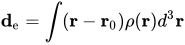
depends on the point about which the moment of the charge distribution is taken. If we were to choose to be the center of charge, then would be identically zero. A more interesting choice would be to take as the electron's center of mass evaluated in the frame in which the electron is at rest.[42]


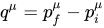
Classical notions such as the center of charge and mass are, however, hard to make precise for a quantum elementary particle. In practice the definition used by experimentalists comes from the form factors appearing in the matrix element[43]


of the electromagnetic current operator between two on-shell states with Lorentz invariant phase space normalization in which

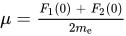
Here and are 4-spinor solutions of the Dirac equation normalized so that , and is the momentum transfer from the current to the electron. The form factor is the electron's charge, is its static magnetic dipole moment, and provides the formal definition of the electron's electric dipole moment. The remaining form factor would, if nonzero, be the anapole moment.[36]






Experimental measurements
[edit]Electron EDMs are usually not measured on free electrons, but instead on bound, unpaired valence electrons inside atoms and molecules. In these, one can observe the effect of as a slight shift of spectral lines. The sensitivity to scales approximately with the nuclear charge cubed.[44] For this reason, electron EDM searches almost always are conducted on systems involving heavy elements.[39]

To date, no experiment has found a non-zero electron EDM. As of 2020 the Particle Data Group publishes its value as |de| < 0.11×10⁻²⁸ e⋅cm. Here is a list of some electron EDM experiments after 2000 with published results:
| Year | Location | Principal Investigators | Method | Species | Experimental upper limit on |de| |
|---|---|---|---|---|---|
| 1958 | Cornell University | Edwin E. Salpeter | Lamb shift | H | 1.54×10⁻¹³ e⋅cm[45] |
| 1963 | Harvard University | Nicolaas Bloembergen | Crystal | Cr:Al2O3 | 1.4×10⁻¹⁵ e⋅cm[46] |
| 2002 | University of California, Berkeley | Eugene Commins, David DeMille | Atomic beam | Tl | 1.6×10⁻²⁷ e⋅cm[47] |
| 2011 | Imperial College London | Edward Hinds, Ben Sauer | Molecular beam | YbF | 1.1×10⁻²⁷ e⋅cm[48] |
| 2013 | Yale University | David DeMille | Vapor Cell | PbO | 1.7×10⁻²⁶ e⋅cm[49] |
| 2014 | Harvard-Yale (ACME I experiment) |
David DeMille, John Doyle, Gerald Gabrielse | Molecular beam | ThO | 8.7×10⁻²⁹ e⋅cm[50] |
| 2017 | JILA | Eric Cornell, Jun Ye | Ion trap | HfF+ | 1.3×10⁻²⁸ e⋅cm[51] |
| 2018 | Harvard-Yale (ACME II experiment) |
David DeMille, John Doyle, Gerald Gabrielse | Molecular beam | ThO | 1.1×10⁻²⁹ e⋅cm[52] |
| 2022 | JILA | Eric Cornell, Jun Ye | Ion trap | HfF+ | 4.1×10⁻³⁰ e⋅cm[53] |
The ACME collaboration is, as of 2020, developing a further version of the ACME experiment series. The latest experiment is called Advanced ACME or ACME III and it aims to improve the limit on electron EDM by one to two orders of magnitude.[54][55]
Footnotes
[edit]- ↑ More precisely, a non-zero EDM does not arise until the level of four-loop Feynman diagrams and higher.[35]
See also
[edit]- Electron magnetic moment
- Anomalous electric dipole moment
- Anomalous magnetic dipole moment
- Electric dipole spin resonance
- Parity (physics) § Parity violation
- CP violation
- Charge conjugation
- T-symmetry
- Axion – a hypothetical particle proposed to explain the strong force's unexpected preservation of CP symmetry
- Electric dipole spin resonance
- Nucleon magnetic moment – the corresponding magnetic property, which has been measured
References
[edit]- 1 2 3 Abel, C.; et al. (2020). "Measurement of the Permanent Electric Dipole Moment of the Neutron". Physical Review Letters. 124 (8) 081803. arXiv:2001.11966. Bibcode:2020PhRvL.124h1803A. doi:10.1103/PhysRevLett.124.081803. PMID 32167372.
- ↑ Dar, S. (2000). "The Neutron EDM in the SM: A Review". arXiv:hep-ph/0008248.
- ↑ Abel, S.; Khalil, S.; Lebedev, O. (2001). "EDM constraints in supersymmetric theories". Nuclear Physics B. 606 (1–2): 151–182. arXiv:hep-ph/0103320. Bibcode:2001NuPhB.606..151A. doi:10.1016/S0550-3213(01)00233-4. S2CID 14168743.
- ↑ Pospelov, M.; Ritz, A. (2005). "Electric dipole moments as probes of new physics". Annals of Physics. 318 (1): 119–169. arXiv:hep-ph/0504231. Bibcode:2005AnPhy.318..119P. doi:10.1016/j.aop.2005.04.002. S2CID 13827759.
- ↑ Smith, J.H.; Purcell, E.M.; Ramsey, N.F. (1957). "Experimental limit to the electric dipole moment of the neutron". Physical Review. 108 (1): 120–122. Bibcode:1957PhRv..108..120S. doi:10.1103/PhysRev.108.120.
- ↑ "Early Fundamental Neutron Experiments at ORNL – ORNL | nEDM".
- ↑ Dress, W.B.; et al. (1977). "Search for an electric dipole moment of the neutron". Physical Review D. 15 (1): 9–21. Bibcode:1977PhRvD..15....9D. doi:10.1103/PhysRevD.15.9.
- ↑ Altarev, I.S.; et al. (1980). "A search for the electric dipole moment of the neutron using ultracold neutrons". Nuclear Physics A. 341 (2): 269–283. Bibcode:1980NuPhA.341..269A. doi:10.1016/0375-9474(80)90313-9.
- ↑ Ramsey, N.F. (1982). "Electric-dipole moments of particles". Annu. Rev. Nucl. Part. Sci. 32 (1): 211–233. Bibcode:1982ARNPS..32..211R. doi:10.1146/annurev.ns.32.120182.001235.
- 1 2 nEDM Collaboration at PSI Website: https://www.psi.ch/nedm/
- ↑ "CNRS movie on n2EDM | UCN Physics | Paul Scherrer Institut (PSI)". 7 November 2025.
- ↑ Ayres, N. J.; et al. (2021). "The design of the n2EDM experiment". The European Physical Journal C. 81 (6): 512. arXiv:2101.08730. Bibcode:2021EPJC...81..512A. doi:10.1140/epjc/s10052-021-09298-z. PMC 8550164. PMID 34720721.
- ↑ TRIUMF Ultracold Neutron Source
- ↑ "nEDM Experiment at the Spallation Neutron Source".
- ↑ Ahmed, M.W. (2019). "A New Cryogenic Apparatus to Search for the Neutron Electric Dipole Moment". Journal of Instrumentation. 14 (11) P11017. arXiv:1908.09937. Bibcode:2019JInst..14P1017A. doi:10.1088/1748-0221/14/11/P11017. S2CID 201646389.
- ↑ "nEDM@SNS - The Neutron Electric Dipole Moment Experiment at the Spallation Neutron Source". nedm.ornl.gov. Oak Ridge National Laboratory. Retrieved 11 Sep 2024.
- ↑ A.P. Serebrov; et al. (2015). "New Measurements of the Neutron Electric Dipole Moment with the Petersburg Nuclear Physics Institute Double-Chamber Electric Dipole Moment Spectrometer". Physics of Particles and Nuclei Letters. 12 (2): 286–296. Bibcode:2015PPNL...12..286S. doi:10.1134/S1547477115020193.
- ↑ A.K. Fomin, A.P. Serebrov (2023). "Simulation of the Ultracold Neutron Source at the Reactor PIK". Technical Physics. 68: 424–429. Bibcode:2023JTePh..68S.424F. doi:10.1134/S1063784223900619.
- ↑ Wurm, D.; et al. (2019). "The PanEDM neutron electric dipole moment experiment at the ILL". EPJ Web Conf. 219: 02006. arXiv:1911.09161. Bibcode:2019EPJWC.21902006W. doi:10.1051/epjconf/201921902006. S2CID 208202103.
- ↑ "Los Alamos Neutron Science Center (LANSCE) UCN Experiments". lansce.lanl.gov. Los Alamos National Laboratory. Retrieved 11 Sep 2024.
- ↑ "Beam EDM - Pulsed Neutron EDM Experiment". 23 December 2020.
- ↑ "hepwww.rl.ac.uk Cryogenic EDM". Archived from the original on 2012-02-16. Retrieved 2009-01-22.
- 1 2 Schiff, L. I. (1963). "Measurability of Nuclear Electric Dipole Moments". Physical Review. 132 (5) 5: 2194–2200. Bibcode:1963PhRv..132.2194S. doi:10.1103/physrev.132.2194.
- ↑ Dekens, W.; de Vries, J.; Bsaisou, J.; Hanhart, C.; Bernreuther, W.; Meißner, Ulf-G.; Nogga, A.; Wirzba, A. (2014). "Unraveling models of CP violation through electric dipole moments of light nuclei". JHEP. 07 (7) 69. arXiv:1404.6082. Bibcode:2014JHEP...07..069D. doi:10.1007/JHEP07(2014)069.
- ↑ Auerbach, N.; Flambaum, V. V.; Spevak, N. (1996). "Collective T-odd and P-odd Electromagnetic Moments in Nuclei with Octupole Deformations". Physical Review Letters. 76 (23) 23: 4316–4319. arXiv:nucl-th/9601046. Bibcode:1996PhRvL..76.4316A. doi:10.1103/physrevlett.76.4316. PMID 10061259.
- ↑ Graham, Peter W.; Rajendran, Surjeet (2011). "Axion dark matter detection with cold molecules". Physical Review D. 84 (5) 055013. arXiv:1101.2691. Bibcode:2011PhRvD..84e5013G. doi:10.1103/PhysRevD.84.055013.
- ↑ Flambaum, V. V.; Feldmeier, H. (2020). "Enhanced nuclear Schiff moment in stable and metastable nuclei". Physical Review C. 101 (1) 015502. American Physical Society. arXiv:1907.07438. Bibcode:2020PhRvC.101a5502F. doi:10.1103/PhysRevC.101.015502.
- ↑ Vutha, Amar (2026-01-13). "What is a Schiff moment anyway?". European Journal of Physics. 47 (3): 035204. arXiv:2601.07217. Bibcode:2026EJPh...47c5204V. doi:10.1088/1361-6404/ae6744.
- ↑ Cho, D.; Sangster, K.; Hinds, E. A. (1989). "Tenfold improvement of limits on T violation in thallium fluoride". Physical Review Letters. 63 (23). American Physical Society: 2559–2562. Bibcode:1989PhRvL..63.2559C. doi:10.1103/PhysRevLett.63.2559. PMID 10040926.
- ↑ Bishof, Michael; Parker, Richard H.; Bailey, Kevin G.; Greene, John P.; Holt, Roy J.; Kalita, Mukut R.; Korsch, Wolfgang; Lemke, Nathan D.; Lu, Zheng-Tian; Mueller, Peter; O'Connor, Thomas P.; Singh, Jaideep T.; Dietrich, Matthew R. (2016). "Improved limit on the electric dipole moment". Physical Review C. 94 (2) 025501. American Physical Society. arXiv:1606.04931. doi:10.1103/PhysRevC.94.025501.
- ↑ Graner, B.; Chen, Y.; Lindahl, E. G.; Heckel, B. R. (2016). "Reduced Limit on the Permanent Electric Dipole Moment of Hg". Physical Review Letters. 116 (16) 16. arXiv:1601.04339. doi:10.1103/physrevlett.116.161601. PMID 27152789.
- ↑ Sachdeva, N.; Fan, I.; Babcock, E.; Burghoff, M.; Chupp, T. E.; Degenkolb, S.; Fierlinger, P.; Haude, S.; Kraegeloh, E.; Kilian, W.; Knappe-Grüneberg, S.; Kuchler, F.; Liu, T.; Marino, M.; Meinel, J.; Rolfs, K.; Salhi, Z.; Schnabel, A.; Singh, J. T.; Stuiber, S.; Terrano, W. A.; Trahms, L.; Voigt, J. (2019). "New limit on the permanent electric dipole moment of using comagnetometry and SQUID detection". Physical Review Letters. 123 (14) 143003. American Physical Society. arXiv:1909.12800. doi:10.1103/PhysRevLett.123.143003. PMID 31702217.
- ↑ Zheng, T. A.; Yang, Y. A.; Wang, S.-Z.; Singh, J. T.; Xiong, Z.-X.; Xia, T.; Lu, Z.-T. (2022). "Measurement of the Electric Dipole Moment of Atoms in an Optical Dipole Trap". Physical Review Letters. 129 (8) 083001. American Physical Society. doi:10.1103/PhysRevLett.129.083001. PMID 36053707.
- ↑ Eckel, S.; Sushkov, A.O.; Lamoreaux, S.K. (2012). "Limit on the electron electric dipole moment using paramagnetic ferroelectric Eu0.5Ba0.5TiO3". Physical Review Letters. 109 (19) 193003. arXiv:1208.4420. Bibcode:2012PhRvL.109s3003E. doi:10.1103/PhysRevLett.109.193003. PMID 23215379. S2CID 35411253.
- 1 2 3 4 Pospelov, M.; Ritz, A. (2005). "Electric dipole moments as probes of new physics". Annals of Physics. 318 (1): 119–169. arXiv:hep-ph/0504231. Bibcode:2005AnPhy.318..119P. doi:10.1016/j.aop.2005.04.002. S2CID 13827759.
- 1 2 Khriplovich, I.B.; Lamoreaux, S.K. (1997). CP violation without strangeness: Electric dipole moments of particles, atoms, and molecules. Springer-Verlag.
- ↑ P. R. Bunker and P. Jensen (2005), Fundamentals of Molecular Symmetry (CRC Press) ISBN 0-7503-0941-5 Chapter 15
- ↑ Roussy, Tanya S.; Caldwell, Luke; Wright, Trevor; Cairncross, William B.; Shagam, Yuval; Ng, Kia Boon; Schlossberger, Noah; Park, Sun Yool; Wang, Anzhou; Ye, Jun; Cornell, Eric A. (2023-07-07). "An improved bound on the electron's electric dipole moment". Science. 381 (6653): 46–50. arXiv:2212.11841. Bibcode:2023Sci...381...46R. doi:10.1126/science.adg4084. ISSN 0036-8075. PMID 37410848.
- 1 2 Arnowitt, R.; Dutta, B.; Santoso, Y. (2001). "Supersymmetric phases, the electron electric dipole moment and the muon magnetic moment". Physical Review D. 64 (11) 113010. arXiv:hep-ph/0106089. Bibcode:2001PhRvD..64k3010A. doi:10.1103/PhysRevD.64.113010. S2CID 17341766.
- ↑ "Ultracold Atomic Physics Group". Physics. U. Texas. Retrieved 13 November 2015.
- ↑ Andreev, V.; Ang, D. G.; DeMille, D.; Doyle, J. M.; Gabrielse, G.; Haefner, J.; Hutzler, N. R.; Lasner, Z.; Meisenhelder, C.; O'Leary, B. R.; Panda, C. D.; West, A. D.; West, E. P.; Wu, X.; ACME Collaboration (October 2018). "Improved limit on the electric dipole moment of the electron". Nature. 562 (7727): 355–360. Bibcode:2018Natur.562..355A. doi:10.1038/s41586-018-0599-8. ISSN 1476-4687. PMID 30333583.
- ↑ Verma, Mohit; Jayich, Andrew M.; Vutha, Amar C. (2020-10-08). "Electron Electric Dipole Moment Searches Using Clock Transitions in Ultracold Molecules". Physical Review Letters. 125 (15) 153201. arXiv:1909.02650. Bibcode:2020PhRvL.125o3201V. doi:10.1103/PhysRevLett.125.153201. ISSN 0031-9007. PMID 33095600.
- ↑ Nowakowski, M.; Paschos, E.A.; Rodriguez, J.M. (2005). "All electromagnetic form factors". European Journal of Physics. 26 (4): 545–560. arXiv:physics/0402058. Bibcode:2005EJPh...26..545N. doi:10.1088/0143-0807/26/4/001. S2CID 119097762.
- ↑ Alarcon, Ricardo; Alexander, Jim; Anastassopoulos, Vassilis; Aoki, Takatoshi; Baartman, Rick; Baeßler, Stefan; Bartoszek, Larry; Beck, Douglas H.; Bedeschi, Franco; Berger, Robert; Berz, Martin; Bethlem, Hendrick L.; Bhattacharya, Tanmoy; Blaskiewicz, Michael; Blum, Thomas (2022-04-04). "Electric dipole moments and the search for new physics". arXiv:2203.08103 [hep-ph].
- ↑ Salpeter, E. E. (1958). "Some atomic effects of an electronic electric dipole moment". Physical Review. 112 (5). American Physical Society: 1642–1648. Bibcode:1958PhRv..112.1642S. doi:10.1103/PhysRev.112.1642.
- ↑ Royce, E. B.; Bloembergen, N. (1963). "Linear electric shifts in the paramagnetic resonance of and ". Physical Review. 131 (5). American Physical Society: 1912–1923. doi:10.1103/PhysRev.131.1912.
- ↑ Regan, B.C.; Commins, Eugene D.; Schmidt, Christian J.; DeMille, David (1 February 2002). "New Limit on the Electron Electric Dipole Moment" (PDF). Physical Review Letters. 88 (7) 071805. Bibcode:2002PhRvL..88g1805R. doi:10.1103/PhysRevLett.88.071805. OSTI 792941. PMID 11863886. S2CID 32396668.
- ↑ Hudson, J.J.; Kara, D.M.; Smallman, I.J.; Sauer, B.E.; Tarbutt, M.R.; Hinds, E.A. (2011). "Improved measurement of the shape of the electron" (PDF). Nature. 473 (7348): 493–496. Bibcode:2011Natur.473..493H. doi:10.1038/nature10104. hdl:10044/1/19405. PMID 21614077. S2CID 205224996.
- ↑ Eckel, S.; Hamilton, P.; Kirilov, E.; Smith, H. W.; DeMille, D. (2013). "Search for the electron electric dipole moment using -doublet levels in PbO". Physical Review A. 87 (5) 052130. American Physical Society. arXiv:1303.3075. doi:10.1103/PhysRevA.87.052130.
- ↑ The ACME Collaboration (January 2014). "Order of Magnitude Smaller Limit on the Electric Dipole Moment of the Electron" (PDF). Science. 343 (6168): 269–272. arXiv:1310.7534. Bibcode:2014Sci...343..269B. doi:10.1126/science.1248213. PMID 24356114. S2CID 564518. Archived from the original (PDF) on 2015-04-27. Retrieved 2014-06-24.
- ↑ Cairncross, William B.; Gresh, Daniel N.; Grau, Matt; Cossel, Kevin C.; Roussy, Tanya S.; Ni, Yiqi; Zhou, Yan; Ye, Jun; Cornell, Eric A. (2017-10-09). "Precision Measurement of the Electron's Electric Dipole Moment Using Trapped Molecular Ions". Physical Review Letters. 119 (15) 153001. arXiv:1704.07928. Bibcode:2017PhRvL.119o3001C. doi:10.1103/PhysRevLett.119.153001. PMID 29077451. S2CID 44043558.
- ↑ The ACME Collaboration (October 2018). "Improved Limit on the Electric Dipole Moment of the Electron" (PDF). Nature. 562 (7727): 355–360. Bibcode:2018Natur.562..355A. doi:10.1038/s41586-018-0599-8. PMID 30333583. S2CID 52985540.
- ↑ Roussy, Tanya S.; Caldwell, Luke; Wright, Trevor; Cairncross, William B.; Shagam, Yuval; Ng, Kia Boon; Schlossberger, Noah; Park, Sun Yool; Wang, Anzhou; Ye, Jun; Cornell, Eric A. (2023). "An improved bound on the electron's electric dipole moment". Science. 381 (6653): 46–50. arXiv:2212.11841. Bibcode:2023Sci...381...46R. doi:10.1126/science.adg4084. PMID 37410848.
- ↑ "ACME Electron EDM".
- ↑ Ang, D. G.; Meisenhelder, C.; Panda, C. D.; Wu, X.; DeMille, D.; Doyle, J. M.; Gabrielse, G. (2022-08-15). "Measurement of the $H^3\Delta_1$ radiative lifetime in ThO". Physical Review A. 106 (2) 022808. arXiv:2204.05904. doi:10.1103/PhysRevA.106.022808.


