


Maier's theorem
In number theory, Maier's theorem is a theorem due to Helmut Maier about the numbers of primes in short intervals for which Cramér's probabilistic model of primes gives a wrong answer.
The theorem states[1] that if is the prime-counting function and , then


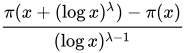
does not have a limit as tends to infinity; more precisely the limit superior is greater than 1, and the limit inferior is less than 1. The Cramér model of primes predicts incorrectly that it has limit 1 when (using the Borel–Cantelli lemma).


Proofs
[edit]Maier proved his theorem using Buchstab's equivalent for the counting function of quasi-primes (set of numbers without prime factors lower to bound , with fixed). He also used an equivalent of the number of primes in arithmetic progressions of sufficient length due to Gallagher.


János Pintz gave another proof,[2] and also showed that most probabilistic models of primes incorrectly predict the mean square error

of one version of the prime number theorem.
See also
[edit]Notes
[edit]References
[edit]- Maier, Helmut (1985). "Primes in short intervals". Michigan Mathematical Journal. 32 (2): 221–225. doi:10.1307/mmj/1029003189. MR 0783576. Zbl 0569.10023.
- Pintz, János (2007). "Cramér vs. Cramér. On Cramér's probabilistic model for primes". Functiones et Approximatio, Commentarii Mathematici. 37 (2): 361–376. doi:10.7169/facm/1229619660. MR 2363833. Zbl 1226.11096.
- Soundararajan, K. (2007). "The distribution of prime numbers". In Granville, Andrew; Rudnick, Zeév (eds.). Equidistribution in Number Theory, An Introduction. NATO Science Series II: Mathematics, Physics and Chemistry. Vol. 237. Dordrecht: Springer. pp. 59–83. ISBN 978-1-4020-5403-7. Zbl 1141.11043.