


Conductor–discriminant formula
In mathematics, the conductor–discriminant formula or Führerdiskriminantenproduktformel, introduced by Hasse (1926, 1930) for abelian extensions and by Artin (1931) for Galois extensions, is a formula calculating the relative discriminant of a finite Galois extension of local or global fields from the Artin conductors of the irreducible characters of the Galois group .


Statement
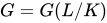
[edit]Let be a finite Galois extension of global fields with Galois group . Then the discriminant equals

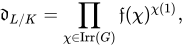
where equals the global Artin conductor of .[1]


Example
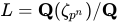
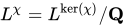
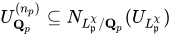
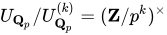
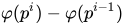
[edit]Let be a cyclotomic extension of the rationals. The Galois group equals . Because is the only finite prime ramified, the global Artin conductor equals the local one . Because is abelian, every non-trivial irreducible character is of degree . Then, the local Artin conductor of equals the conductor of the -adic completion of , i.e. , where is the smallest natural number such that . If , the Galois group is cyclic of order , and by local class field theory and using that one sees easily that if factors through a primitive character of , then whence as there are primitive characters of we obtain from the formula , the exponent is










Notes
[edit]- ↑ Neukirch 1999, VII.11.9.
References
[edit]- Artin, Emil (1931), "Die gruppentheoretische Struktur der Diskriminanten algebraischer Zahlkörper.", Journal für die Reine und Angewandte Mathematik (in German), 1931 (164): 1–11, doi:10.1515/crll.1931.164.1, ISSN 0075-4102, S2CID 117731518, Zbl 0001.00801
- Hasse, H. (1926), "Bericht über neuere Untersuchungen und Probleme aus der Theorie der algebraischen Zahlkörper. I: Klassenkörpertheorie.", Jahresbericht der Deutschen Mathematiker-Vereinigung (in German), 35: 1–55
- Hasse, H. (1930), "Führer, Diskriminante und Verzweigungskörper relativ-Abelscher Zahlkörper.", Journal für die reine und angewandte Mathematik (in German), 1930 (162): 169–184, doi:10.1515/crll.1930.162.169, ISSN 0075-4102, S2CID 199546442
- Neukirch, Jürgen (1999). Algebraische Zahlentheorie. Grundlehren der mathematischen Wissenschaften. Vol. 322. Berlin: Springer-Verlag. ISBN 978-3-540-65399-8. MR 1697859. Zbl 0956.11021.